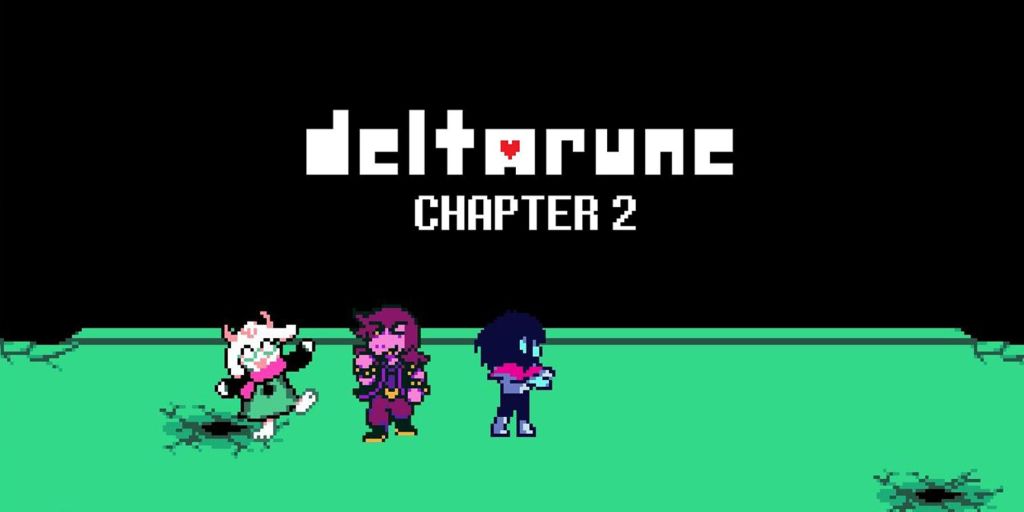
After three years of anticipation, Deltarune: Chapter 2 has arrived, and with it, the ongoing story of Toby Fox’s work has re-immerged. After Undertale‘s massive success in 2015, it would be putting it lightly to call the fandom culture surrounding these games… extensive. There is no stone unturned, no source code left unread, and no theory left unexplored. I’ve been thinking about my own interpretation of Undertale, and how Deltarune has thus far mirrored some of the same themes: specifically its metanarrative on gaming as a participatory medium. I say “thus far,” because the story of Deltarune’s world is incomplete, and I am fully aware that whatever I write here has the possibility to age poorly. Despite Toby giving us hints stating Deltarune takes place in an alternate universe, we still do not know if the two games share a connection beyond having some of the same characters. With two out of seven chapters completed, we are not even half-way through this story. For now, there is an idea that should be explored: how the player, themselves, can be the villain in Deltarune’s story.
The Player as the Villain of Undertale
To understand why the player could be the villain of Deltarune, we should analyze Toby Fox’s original game because his meta-commentary draws players’ attention to their role in playing games. In Undertale, the most powerful and pervasive force is empathy. When given the choice to spare or kill your enemies, the game works on our preconceptions of video games, subverting the necessity to solve conflict with violence, and villainizing our intrinsic need to use violence to see what happens. Ripping the happy ending away from the characters just because we want to see what would happen — just because we can — is not a victimless crime, but rather, something to be held accountable for.
In fact, the only way to get a true good ending in Undertale is by being a complete pacifist. If you manage to succeed, the game ends with a vision of untainted hope: Frisk and all of their friends watch the sunrise, showing that monsters and humans can live in harmony, and a new day is dawning for these united worlds. This ending is a perfect bow on a wholesome story about friendship and spaghetti skeletons.
In comparison, the no mercy run, or the “genocide” run, ends with the original fallen human, Chara, speaking directly to the player, imploring us to reset the game after we plunged it into ruin by murdering every single monster in the underground. Chara actually speaks to the player directly because Frisk is not on screen to act as a distancing mechanism, and Chara knows that something is going on beyond their perceptions of their reality, just as Flowey does. If you play a no mercy run of the game and then restart to attempt a pacifist run without deleting the game files first, Chara will possess Frisk at the end of the game, ruining your happily ever after. They know what you did.
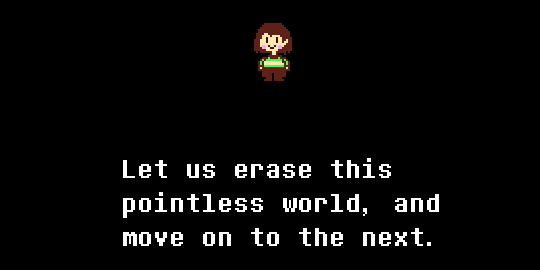
As a result, the community’s consensus became that Chara was the true villain of Undertale. While I understand this interpretation and even shared it at one point, I think it contradicts the power of empathy in the story. If we can spare Asgore, who has murdered multiple children on his quest to free monsters, and we can spare Asriel, whose soulless form, Flowey, attempted to destroy everything out of pure spite, why is it so easy for us to shift the blame onto the ghost of the first fallen child? If the themes of this game are to remain consistent, Chara must be a victim of the world as much as any other character, and must react to the choices you make influencing the world, just like the rest of the characters. The only difference between Chara and the other characters is that they are not alive and present in the pacifist run to defend themselves. There is a widely circulated theory that attempts to explain Chara’s absence. If Chara is the narrator of the game, their personality is shaped by your decisions, whether you decide to spare or kill your enemies. There is no substantial, canonical evidence for them being the narrator, but the theory is compelling because it places responsibility on the player and implies that Chara’s heel turn is our doing. Regardless, the true villain of Undertale is still textually us because our decisions alone influence the outcome of the game. Now, I cannot speak to the individual intentions of every player, but the player is the one taking the initiative to see what happens, and the player is the one systematically killing all the monsters in order to do so, not Chara. The save files “remembering” what we did speaks to the importance of player choice.
The Player as the Villain in Deltarune?
In the first chapter of Deltarune, the character customization screen is a ploy. We get to pick out a name, hair style, clothing, etc. for our “vessel” only for a disembodied voice to tell us that we do not get to choose who we are in this world. Before the voice directly tells us that the decisions we made do not matter, there is a joke that implies our choices are meaningless: a screen where you have to pick a pair of legs, and all of them are exactly the same. The voice asks some absurdly detailed questions about our vessel; its favorite foods, blood type, and color. Right from the beginning, we are looking for another vessel to embody — an “it” — and we are told that none of our selections impact who they are. We do not get to pick anything about them. We did not get to pick anything about Frisk, either, because it is revealed later that naming the fallen human was a clever misdirection of wordplay and we were naming Chara. Yet, Frisk is often interpreted as a purposefully ambiguous silent protagonist that we can inject ourselves into, which aligns with the game’s message about personal responsibility. For 2015, having a character without a canonical gender was interesting and progressive in terms of accessibility, and it facilitated Toby Fox’s subversion and commentary on gaming. On the other hand, Kris is not someone that the player can project our identity onto. They have family, friends, and go to school. All of the characters refer to Kris with they/them pronouns, which is independent from the gender of whoever is playing. Our choice of vessel does not matter, remember, so rather than Kris being a character without a canonical gender, it is fair to make the distinction that they are outside of the gender binary. There is nothing that the player can do to alter the story or the ending of these chapters in any significant way. The first chapter of Deltarune differs from Undertale in that you cannot kill any of the Darkners; if you attempt to fight instead of heeding Ralsei’s advice, all of your enemies will simply run away from you. So, it would seem, that chapter one works with the illusion of choice. At the end of the first chapter, Kris throws their heart into a cage, and goes to, as we can now infer, open the second portal to the Dark World in the computer lab.
How much is Kris aware of our control? During the pacifist Spamton NEO fight, the object of the fight is to snap his wires. There is text that says “the air crackles with freedom” and “it pulls the strings and makes them ring.” Spamton asks Kris: “DO YOU WANNA BE A [HEART] ON A [CHAIN] YOUR WHOLE LIFE!?” After you cut his wires, he becomes invigorated with the possibility of freedom: “KRIS…YOU…YOU’RE [Gifting] ME MY [Freedom]?!” He subsequently falls onto the floor motionless, unable to move on his own without his wires: “It seems after all I couldn’t be anything more than a simple puppet. But you three…You’re strong. With a power like that…Maybe you three can break your own strings.” After the fight, Kris begins to yell, and Susie and Ralsei attempt to calm them down. Kris is shaken by this fight, and perhaps, when they rip their soul out of their chest and throw it into a prison, they are aware of our control, how the representation of our control is that heart on the chain, and how to temporarily sever that connection to cut their metaphorical strings. They may also be aware that without our control, like Spamton, they will just break and cease to exist. An example of our connection being temporarily disrupted occurs when Ralsei wants to speak to Kris alone, which happens once in each chapter. Ralsei will urge the player to look at what Susie is doing for a while and control her, and does not easily acquiesce if we say no. When our attention is back on Ralsei and Kris, they will be in the middle of a conversation we were not privy to. Ralsei is also more likely to brush things off than Susie is. After the Spamton NEO fight, Susie is a bit freaked out and confused, understandably, but Ralsei tells her not to worry about anything that just happened because he is their ally now. These instances, among others, have garnered some speculation that Ralsei is hiding something. There is no evidence that he is secretly orchestrating a sinister plot, but it seems he knows more than he is letting on, and his motivations for distracting the player or dissuading questions are unclear. If the player is the villain of Deltarune, perhaps the game will culminate with the characters eventually turning against us to cut their own wires.
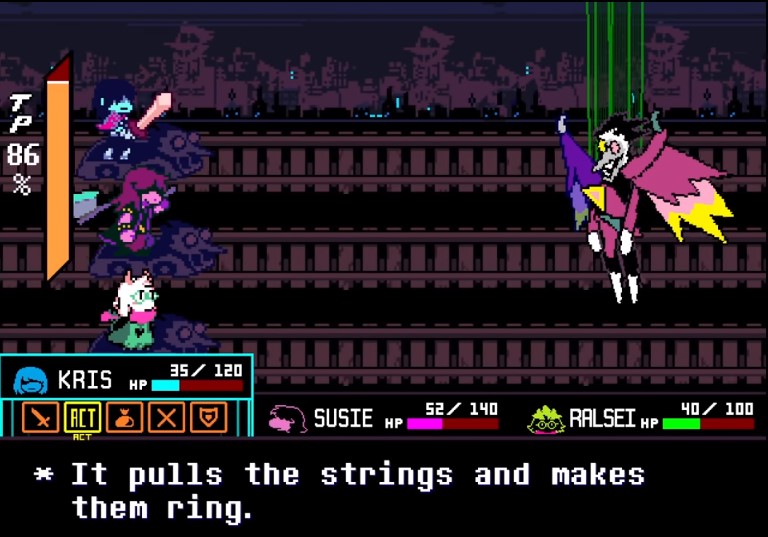
Along with the player pulling these wires, the game suggests that Kris, Ralsei, and Susie have these archetypal roles to play in a prophecy. This chapter may seem to contradict the thesis of the first one, as it shows that diverging from the path can have terrifying, existential implications for the characters in the game, but I now interpret the game as having a set destination with different options on how to get there. In the first chapter, our choices did not have any impact on the basic bullet points of the plot, however, whether we spared or fought enemies did result in their willingness to help us against Lancer’s father. Our choices do matter in chapter two in a more obvious way, specifically, in how we can now manipulate others into killing for us. The second chapter gives us a bit of autonomy to do some pretty dreadful things using Kris as our vessel. Of course, I am referencing the now infamous “weird” route, also known as the “Snowgrave” route. The weird route consists of the player controlling Kris to manipulate Noelle into killing enemies. Although Kris is their own person as we have previously established, we are picking what they say to Noelle, like a puppet master behind the scenes. In my opinion, this route is much less intuitive to the player than the no mercy route of Undertale, and it is much easier to accidentally abort by picking the “wrong” option. The wrong option, being, whatever does not assert absolute dominance in any given situation. This route does significantly change the game because if you use Snowgrave on Berdly during his battle, he does not wake up with everyone else in the computer lab. It is still possible that he could be alive frozen in the ice, but we will not know until the next installment. Noelle also seems changed by her actions, albeit she is not fully cognizant of them. She refers to her time in the Cyber World as a dream, as if in denial. When she returns home, there is a definitive change in her confidence and her interactions with other characters. Even her sprite animation changes throughout the course of the route. She goes from afraid of fighting, to easing into another battle, knowing she can handle herself. Although it is too early to say for sure, the Snowgrave route has some intriguing, cosmic horror implications about our control and manipulation of the characters in the game, much like the Spamton NEO fight suggests. Noelle can rationalize her actions because her childhood friend is urging her to embrace her inner strength; she thinks Kris has her best interest in mind, and would only push her to test her abilities.
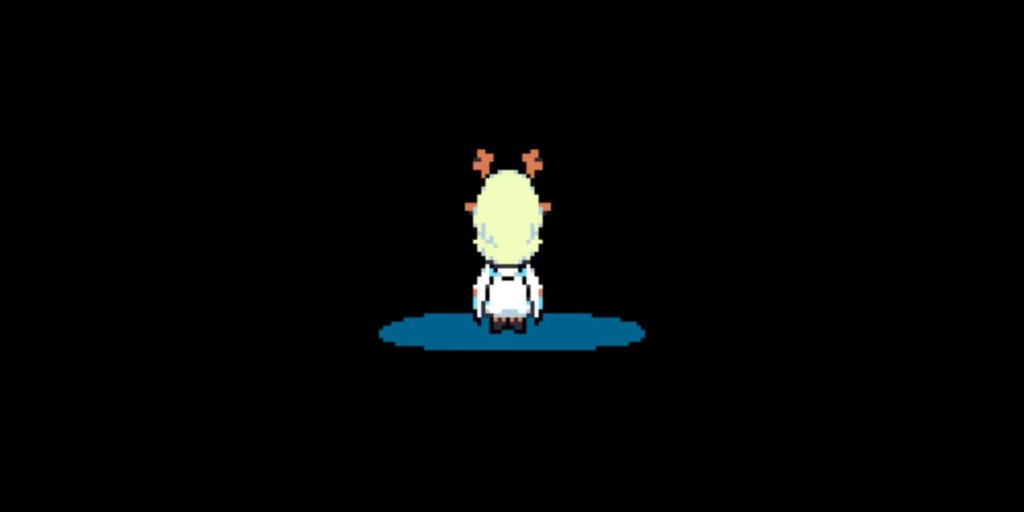
In his video, Noelle’s Actions In Deltarune Explained, Daryl Talks Games posits that both routes have a similar underlying theme and end-point to Noelle’s arc: she becomes stronger over the course of the game. The way we get to that point, however, depends on if we choose the normal or weird route. In the normal route, Noelle finds her strength through the positive reinforcement of her friends, wanting to protect them. However, in the weird route, Noelle gains confidence to assert control over others with ice magic. Although Toby is going with a Christmas theme, I do not think it is a coincidence that her power is cold from a thematic standpoint. Her strength derives from an icy force that forms like a callous to protect and shield her from anxieties of uncertainty and powerlessness. Daryl makes the argument that Noelle feels helpless in both runs, unable to control the world around her, but the way she grows from her helplessness is different depending on the player’s decisions:
Both ways to play chapter two complete Noelle’s character arc in the same way, the real difference being, does she grow from the love and support of Queen and her friends, or does the player demanding she see how strong she is result in her finding a part of herself she locked away?
As the video mentions, it is possible that Noelle’s fears of losing her loved ones could have caused her to view her choices as insignificant because she cannot heal her father who is in the hospital. Despite this inability to save her family, she gains the confidence to stand up for herself and see that her choices do matter. In one route, she does so out of fear that losing control will make her weaker, and in another, she finds strength in bonding with those around her. Perhaps, the decisions that we make might not “matter,” in the sense that they will not change the ending of the game or its chapters, but we can see in chapter two that the actions we take moment-to-moment give us power, even if our control is not absolute. What we do with that power, like in Undertale, does reflect on the kind of gaming experience we want to have. Our participation and control over the characters creates an accountability for our decisions. The player cannot alter the ending of chapter two — Kris is always going to open another portal in their living room and Noelle is going to become a stronger person — but that does not mean our choices do not have an impact.
Concluding Thoughts
The second chapter of Deltarune was incredibly thought-provoking. The lighthearted nature of the characters serves as a great contrast to the existential, cosmic horror surrounding the story. As someone who did not actually play the weird route on my own, I cannot wait to see these characters and their relationships explored more thoroughly, and how the weird path will change those relationships, for better or for worse. I cannot help but see shreds of the Chara theory mirrored within these characters in the way that their power, strength, and determination is dictated by our actions. Adding these layers to flesh out the motivations and backstories of Noelle and Kris might reveal the player as the villain of the story in a clearer or different way than Undertale did. I hope Deltarune continues to explore video games as a medium, and how the player’s active participation in the narrative affects the characters we try to embody as our vessels.


Leave a Reply