
Denis Villeneuve’s Dune (2021) is a science fiction epic based on Frank Herbert’s book series. The central protagonist, Paul Atriedes, must learn to harness the power he inherits from his birthright to integrate into the society of the Fremen and bring peace to their people from the oppressive forces in the universe that seek to harvest an invaluable resource known as spice. In order to do so, Paul must shed the hubris of his father’s legacy whilst also learning to hone the feminine power of the voice to become a chosen savior. Although there is another installment set to release in 2023, this film lays the foundation of the various political conflicts within Herbert’s universe. I have not read these novels and cannot speak to Villeneuve’s movie as an adaptation, but I can speak on the text in isolation so far, which I found to be an interesting and complex commentary on oppression, anti-colonialism, and gender, albeit with these threads incomplete.
Part 1: The Hubris of Man
One of the reoccurring thematic symbols in Denis Villeneuve’s Dune (2021) is the bullfighter. We first see this imagery at the start of the film when Paul (Timothée Chalamet) and his mother, Lady Jessica (Rebecca Ferguson), have breakfast on their home planet, Caladan. The house of Atreides is linked to the image of the bull, and they display the head of the slaughtered bull that fatally gored Paul’s grandfather, Duke Paulus Atreides, on their wall as a symbol of the hubris of man. This hubris follows Paul’s father, Duke Leto Atreides (Oscar Isaac), who makes the same mistakes as Paulus when beckoned by his Emperor to oversee the spice manufacturing on the harsh titular dune. Additionally, Paul studies a small statue of a bullfighter waving his cape towards an oncoming bull throughout the film, and this statue’s significance becomes more evident as the plot progresses. The bullfighter statue foreshadows Leto’s death on Arrakis and his betrayal at the hands of the Emperor. It also begins to symbolize the hubris of man’s war against the natural world and themselves. However fair his principles were, Leto was still an unwelcome oppressor to the natural ecosystem and native population on Arrakis. Despite his efforts to harvest the spice amicably and communicate with the Fremen who live there, he was still participating in and perpetuating a cycle of colonialism, war, and death. Paul must break this cycle in order to bring peace to Arrakis.
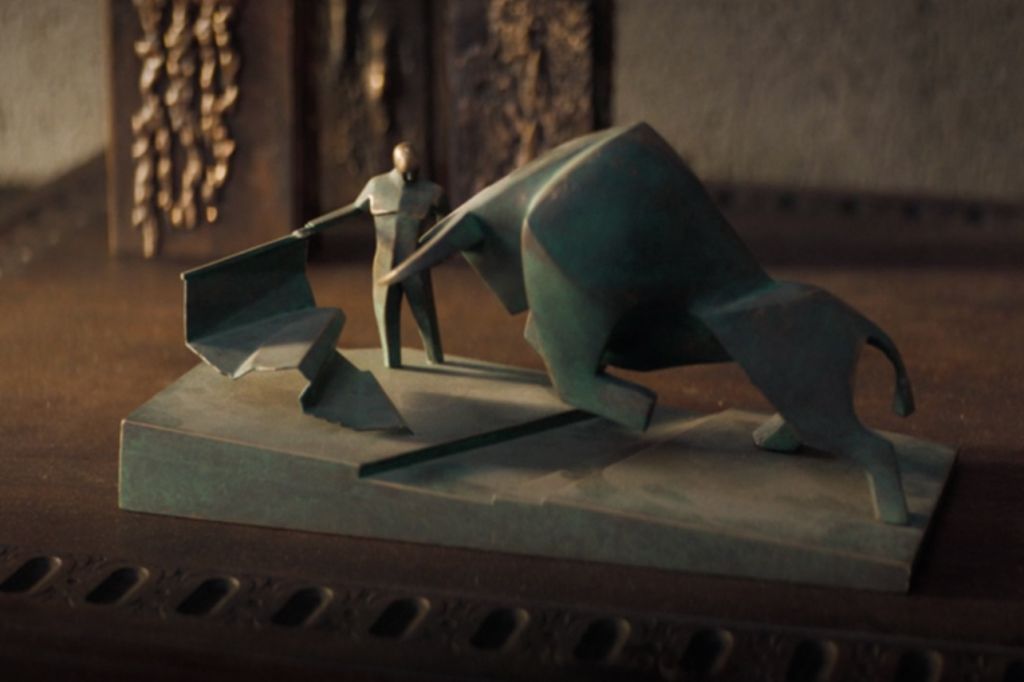
Villeneuve draws our attention to the bull’s head and the bullfighter statue many times during the film; as noted above, its first appearance is during a scene with Paul and his mother. The statue is placed under a portrait of Paul’s grandfather, indicating that the memory of the Old Duke still presides over the family as a warning to the future patriarchs of the house. When Paul and Leto meet amongst the graves of their people, they briefly discuss how Paul’s grandfather killed bulls for sport. Leto remarks, “see where that got him.” The presence of death marks the start of their journey, and this line shows us that Leto sees his father’s death as an act of selfish recklessness that could have been prevented. During this conversation, we get a glimpse at another significant object of the story, Leto’s ring, which comes to symbolize the role of the Duke of Atreides itself. However, Paul is not keen on accepting the ring at this time, despite being next in line. Later, Paul’s coming-of-age culminates in putting on the ring after his father’s death.
After signing the agreement with the Emperor, the Atreides bring both the bull’s head and the bullfighter statue with them to Arrakis, showing that they cannot escape their family’s history. On the night that the Harkonnens attack them, Paul examines the statue of the bullfighter, while in another room Leto confides in Jessica that he fears the future. The Harkonnens are another house in Dune; they controlled the spice manufacturing on Arrakis before the Atriedes, and their reclamation of it is the central conflict of the story. Their characterization is violent, ruthless, and brutal, and their planet is rife with bleak industrialization. When he is captured by the Harkonnens, Leto is brought to his chamber and placed underneath the bull’s head while the Baron and his men celebrate their accomplishment. After Leto dies, the camera pans to the bull’s head on the wall for a final time, highlighting the hubris of their family.
As noted by Brian Silliman:
Paulus, full of honor and hubris, willingly walked into an arena. He did not expect to die, but the bull from Salusa Secundus gored him to death. Leto does the same; full of honor, he walks right into a trap. He doesn’t expect to die, but look what happens to him.
Syfy
Although Leto surrounds himself with reminders of his father’s hubris, he befits the same, depressing end. Leto is a complicated character; he clearly has noble and altruistic intentions during the film to bring peace to Arrakis. He values human life over the spice because when he sees that a sandworm is going to eat one of the harvesting vehicles; he puts his own life in danger to save people and abandons the ship’s cargo. He also does not pressure Paul to take up the mantle as Duke, insisting that the only thing he ever wanted Paul to be was his son. Leto encouraged Paul to find his own way, knowing that he may just fulfill the role on his own terms one day rather than out of obligation. However, despite the positive attributes of his character, Leto is still beholden to a patriarchal role. As the head of an important house, he cannot decline an invitation to rule on behalf of the Emperor. In his own way, he was waiting for the stewardship, and he began to think about how it could benefit him and his house. By going to Arrakis, he still attempts to be a ruler and conqueror in his own right. He doesn’t wish to liberate the Fremen; instead, he aims to ally with them in order to use their strength against his enemies. He wants to befriend them for political reasons; if he has their power, the house of Atreides commands more respect on the galactic stage. However, although he wants to form this alliance, he does not show concern for how the spice trade itself is harming the Fremen or how taking these resources away from them is hurting their culture and their way of life. Mutually beneficial tolerance from an oppressor does not subvert the power dynamic, and therefore, his noble intentions amount to little.
The symbol of the bull becomes exemplary of the Emperor, who conspires to end house Atreides. Leto enters this arena to expand his own influence, power, and wealth, but ultimately dies because there is no way to be honorable in this world of imperialist war culture; there is no way to be a tolerant, kind oppressor. Ultimately, Leto’s intentions are unimportant to the ones he ruled over; countless men like him had tried to to rule Arrakis and harvest its spice in the past. Leto succumbs to his own hubris because the only true path for the Fremen is revolution and liberation.
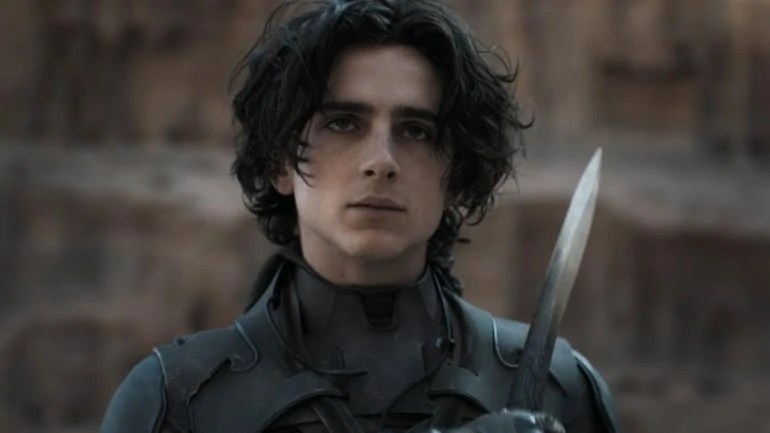
When Leto dies, the bull remains with him, while Paul carries on with his father’s ring. In wearing it, Paul signifies that he may have shed the legacy of the bullfighter, but still retains his birthrights. He steps into this role as a leader to avenge his father and liberate the Fremen. In order to bring peace to Arrakis, Paul cannot be a foreign ruler that participates in settler colonialism; he must live amongst the Fremen and learn their culture. Navigating the desert requires a level of respect and understanding; he must walk like the Fremen to mimic the natural vibrations of the sand and avoid attracting the attention of the sandworms. The sacred weapon of the Fremen is the crysknife, made from the tooth of a dead sandworm. By wielding this knife, Paul must use the sandworm as his ally against the forces that face his family and the Fremen instead of succumbing to the environment like his father did.
Part 2: The Feminine Power
Paul inherits more power than just his father’s; in fact, it is his mother’s strength that plays a predominant role in his story. His mother comes from an order known as the Bene Gesserits, who are a pseudo-religious organization comprised entirely of all women. In addition to manipulating those around them through their political maneuvers, the Bene Gesserits can directly control others through the use of their voice. Their ultimate goal is to facilitate the birth of a “chosen one,” or “Kwisatz Haderach,” a male Bene Gesserit who will bring a better future. They were hoping to achieve this plan by consciously breeding certain bloodlines together across thousands of years. In her own hubris, Jessica disregards these plans and purposefully gives birth to Paul a generation early when she was supposed to have a daughter. Although the film does not delve too deeply into the complete role of this order, it seems clear that they are another oppressive force in the universe using genetic experimentation in order to create “a superior breed” of human beings, which makes them, at the very least, eugenicists. In its own way, Jessica’s desire to give birth to the chosen one is an act of resistance against the order’s wishes, despite being based in her own selfish reasoning. Paul’s existence defies thousands of years of planning and his role as the chosen one is put into question. As a result, the power of the voice, when used by Paul or Jessica, can be interpreted, not just as a force of manipulation, but as a feminine resistance against oppression.
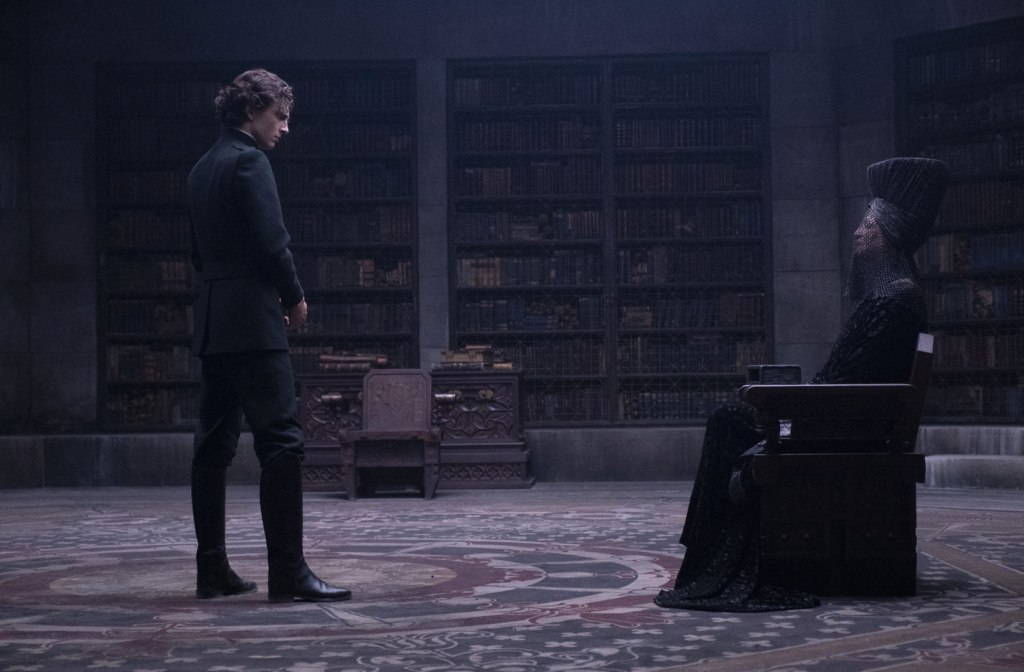
When Paul faces the Reverend Mother of the Bene Gesserit, Denis Villeneuve mentions that he wanted the scene to feel completely oppressive:
Greig [Fraser] and I had tried to create a feeling of oppression and making sure that the room felt closing on Paul, that there is no way to escape. The Reverend Mother is designed to make sure that she will look like towering over him.
Vanity Fair
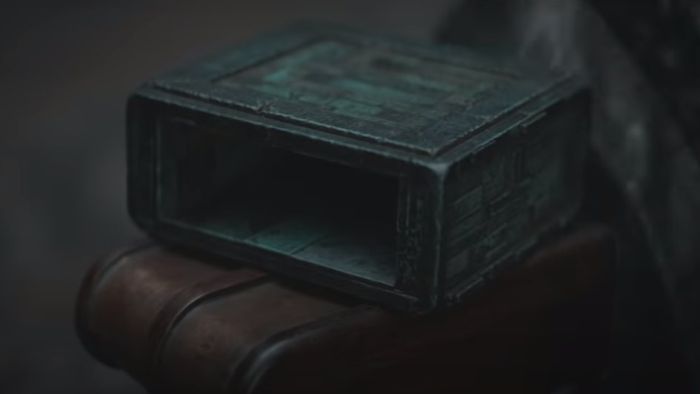
She puts his hand in the box to see if he can control his impulses and use his humanity to triumph over the pain, or if he would do something impulsive that could put his own life in danger, as an animal would. I do not think it is a stretch of the imagination to look at the box as vaginal and this experience as a test of more than one type of impulse. As Paul’s hand is in the box, something changes. He sees fire. The Reverend Mother senses that something in him changed, and in that moment, he subverts their power dynamic. She no longer retains control over him.
The other power that Paul receives from his mother is the ability to see visions of the future. Whether prompted by his sensitivity to the spice or his dreams, these visions are abstract with some truth littered between the confusing and often violent imagery. Paul predicted his friend Duncan’s death and even saw the exact way he would die, though he did not anticipate that Duncan (Jason Momoa) would be killed while protecting him. Earlier in the movie, Paul tries to accompany Duncan on a mission to prevent him from getting killed. He does not prevent his death from occurring. Many of Paul’s dreams are about the Fremen woman, Chani (Zendaya), who he meets towards the end of the film, but in one of these visions, her hand is bloody holding a crysknife. Because of these scenes of blood, death, fire, and war, Paul becomes increasingly aware of the possibility of his own death and more self-confident in his place as a leader against the Emperor. Paul also envisions a Fremen who will lead him through the desert and teach him the ways of their culture; this man ends up challenging him because he is an outsider, and Paul kills him in a battle, despite initially wanting to spare him. This man did not act as a mentor to Paul, but he does teach him something valuable about the Fremen culture, as well as symbolically “killing” the person that Paul used to be by forcing his hand. Although the vision was abstract and confusing, the end result was similar to what he imagined.
In a way, Paul’s two birthrights make him a bridge between the masculine and the feminine. Although he is not killed, he “dies” twice in the movie; once, when he puts his hand in the box to test his impulses, and again when he is forced to end the Fremen’s life through combat. Paul’s strength comes not only from his physical prowess, but also from his mental training and his power to be intuitive towards other people’s emotions and needs. His connection to his father was so powerful that he knew when he died despite not seeing it with his own eyes, and likewise, his connection to his mother is also incredibly strong. He knew she was pregnant, even if she barely knew herself. In listening to others or having this supernatural intuition, he becomes a leader that does not seek to oppress, but aims to communicate and overcome mutual obstacles. He cannot succumb to his impulses or seek political power like his father did, nor can he blindly follow the Bene Gesserit’s plans.
Part 3: Anti-Colonialism and White Savior Narratives
Dune (2021) is blatantly progressive in its take on capitalism and colonialism; as Villeneuve discusses for Vanity Fair: “There’s no computers in this world. In Dune‘s world, AI has been banned. There’s no more artificial intelligence. Dune is about triumph of the human spirit.” Dune‘s setting takes place in the future, but a future that is still dominated by the importance of capital, profit, and colonists that deplete a planet’s resources for their own personal gain. In the city of Arrakeen, palm trees that are not indigenous to the area are fed precious water while Fremen and other refugees struggle to survive in the desert heat, and the Fremen living on the outside of the city must use special suits that recycle their bodies fluids to not die of dehydration and heatstroke.
Throughout the film, Paul listens to educational tapes about Arrakis that are written from the perspective of the imperials; they discuss the importance of spice, but note that there is still much to learn about the Fremen. Although the Fremen are immediately “othered” by these tapes, Paul seeks to understand them. The spice is vital for space travel, but it is also psychoactive. Spice is also used to make explosives and other things. As a result, whoever holds the spice effectively holds the power to the future of humanity and the biggest commodity in the known universe. As Chani notes in the introduction, when the Harkonnens controlled spice production, “they became extremely rich,” which is confirmed with the industrial hellscape of their home planet.
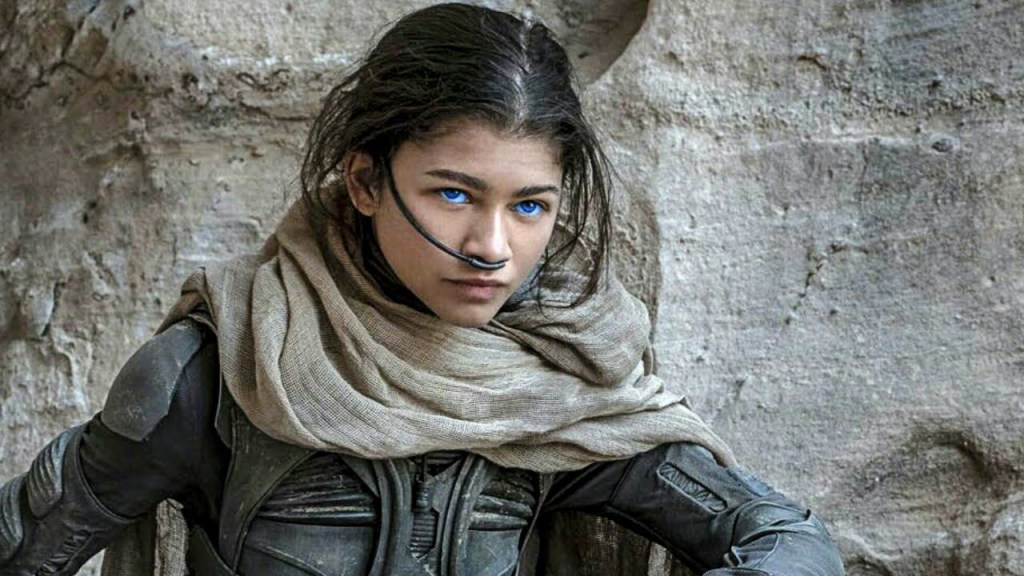
Early in Dune, Chani asks, “who will oppress us next?” as the cycle of spice production and oppression continues. As an audience, we are meant to “side” with the Fremen and their plight against the Emperor’s rule. With Paul as our protagonist on his own journey, we are meant to empathize with their plight and his wishes to bring peace and avenge his father’s death. This dynamic leads to a precarious representation of Paul as a possible white savior. A white savior refers to a character who rescues or saves non-white people from their circumstances, namely, in the case of Dune, Paul acting as a savior to the Fremen. Ali Karjoo-Ravary discusses Frank Herbert’s novel as one that “drew from Islam to critique the idea of the messianic Western man.”
Herbert writes that his story ‘began with a concept: to do a long novel about the messianic convulsions which periodically inflict themselves on human societies.’ In so doing, he was particular that it was ‘Western man’ who was the focus of his ire, who uses this ‘messianic impulse’ to control other societies and further ‘inflict himself on the environment.’ Dune relies heavily on Islam to build its universe. For Herbert, Islam is a major part of human heritage and, by extension, its future. His use isn’t simple window dressing either: It shows a deep engagement with both the beliefs and histories of a wide variety of Muslims.
Slate
I recommend reading the entirety of Karjoo-Ravary’s fascinating article about this subject. Even without the context of the source material, it is not hard to see why Dune (2021) is being criticized as a white savior narrative. Despite being a critique of exploitative whiteness and colonialism, Paul is the center of the story. Because of this, Dune participates in a certain orientalism that its adaptation cannot shake, especially because the films features actors of color in the role of Fremen that were not Middle Eastern, further complicating the racial allegory. From my perspective as an American, our media is not known for its nuanced portrayals of Muslims, and Islamophobia is still unfortunately rampant in many countries. While Dune critiques colonialism and calls for us to empathize with the Fremen, it cannot completely shed its place in that history fifty years later as its original publication. It is possible that Dune criticizes the hubris and selfishness of white oppressors whilst also participating in unfortunate framing.
Conclusion
As noted in his video Why Dune’s Visual Effects Feel So Different, Thomas Flight talks about how the digital camera in the movie is relatively constrained and grounded in the perspectives of the characters. In contrast with modern superhero movies, which often use light work and green screen effects that look unnatural, Dune‘s visuals rely on practical effects enhanced by digital technology to convey a more realistic feel. This choice to make the camera more grounded to the characters gives the movie an epic scale; we feel the vastness of the desert as if we are standing there. It also works on a deeper level, where the story itself is grounded in the perspectives of the characters. I think this decision to make a movie about anti-colonialism hyper-realistic means we are meant to empathize with them and the harshness of their world, so we do not float too far away from the action. We are in the thick of it with them, even if it means our view is sometimes partially obscured by another object in the frame. Villeneuve envisions Dune as a story about the triumph of humanity’s spirit that is grounded in human emotions and perspectives. Despite its flaws and muddled commentary on race, the collective power of the Fremen speaks to the strength of humanity’s spirit to survive under the tyrannical rule of the rich and powerful. Paul’s legacy acts as a defiance to his oppressors and the parts of his legacy that he rejects in order to bring peace, flying in the face of allegorical Western colonialism.


Leave a Reply