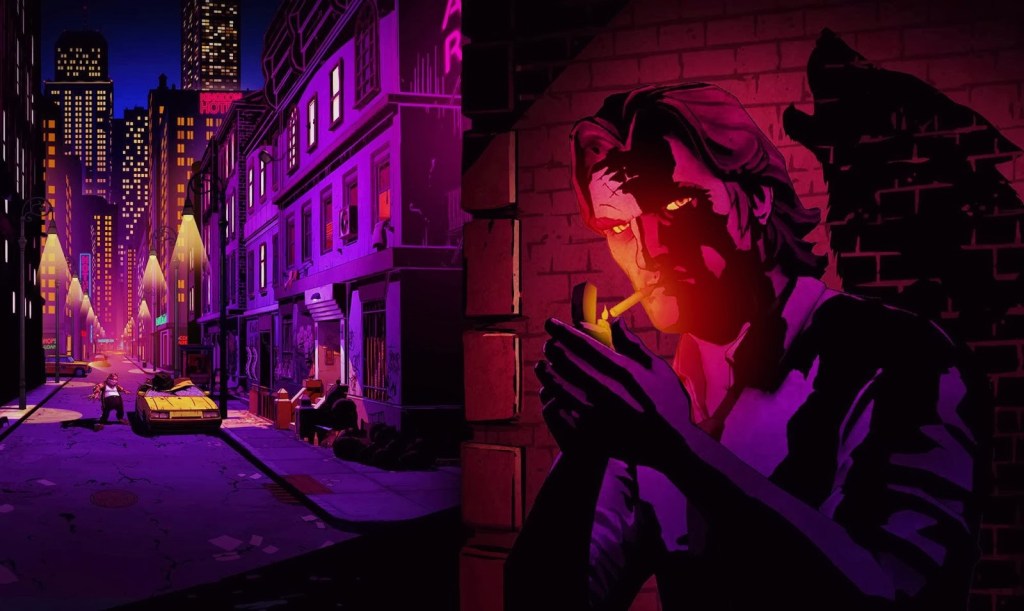
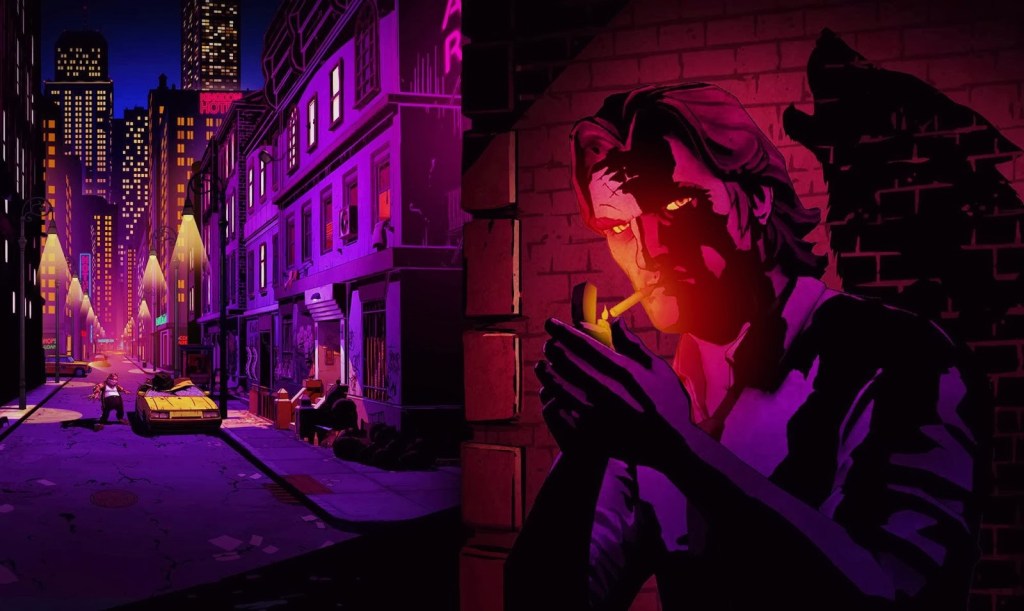
The Wolf Among Us is a mystery-drama adventure game consisting of five episodes developed by Telltale Games based on the Fables comic book series, using characters that originate fairy tales and folklore. The main plot surrounds the events of two murders within Fabletown, New York City, and the person tasked to solve them, antihero Sheriff Bigby Wolf (formerly known as the Big Bad Wolf). In terms of gameplay, the majority of The Wolf Among Us consists of dialogue trees and quick time events. Some player choices impact the story significantly, and others merely give the player the illusion of choice without impacting the overall narrative. Depending on the choices you make, you can play Bigby as a flawed man grappling with his demons, trying to gain the trust of the community and right the wrongs of his past, or you can play a violent detective who reverts to his predatory instincts, killing or mutilating people who stand in his way. In any case, the central narrative is based in ambiguity. Not all is as it seems. Whether that ambiguity comes from the characters’ themselves, their tales, the themes, or your choices, the game exists within shades of gray.
First and foremost, I want to put a general disclaimer: this essay is about the game as a solitary text, and not the Fables comics or their contentious writer. Second, this essay is targeted towards those who have played all of the episodes of the game. If you have not played the game yet, I recommend reading some content warnings to make sure that it is the right fit for you. I will preface my points with refreshers, but an entire plot summary would be way too extensive, and the game is a mystery, after all. I don’t want to spoil it. This essay will also not focus on the many idiosyncrasies of the game and which paths the player can choose to go down, but rather, its social commentary on the disenfranchised, whose stories are often ignored by those in power, and its meta-textual criticisms, specifically, how the brutality of the fairy tales lends itself so well to the genre of gritty noir. In terms of whether it is a successful subversion: much like the ending leaves us without any definitive answers, I will let you decide.
Our first introduction to social hierarchies imposed by the Fabletown government comes in the form of Toad, a walking three-foot amphibian slumlord of The Wind in the Willows fame who calls Bigby to his aid in episode one. Toad makes no effort to conceal his appearance with glamour, which is at odds with the Fabletown laws. Glamour is a spell that makes inhuman Fables appear to be human; it is extremely expensive and is produced by certified witches and wizards that reside in the Woodlands Luxury Apartments using limited magical resources. Those who look human without its aid have a natural privilege and advantage in this new society outside of the Homelands. The purpose of glamour is to hide the existence of Fabletown from the “Mundys,” or “mundanes” — regular human beings like you and me. When a Fable does not use a glamour and cannot access one, they are sent to “the Farm” — a community in upstate New York that is relegated to the animals, trolls, and other various creatures that cannot walk around New York City without raising suspicion. That being said, if you’ve ever been to New York City , you probably wouldn’t care about a pig smoking a cigarette if it was during rush hour on the subway. Because they can’t leave, however, the Farm is regarded by some of the characters as a prison because they give up their freedom to be who they truly are. Some characters, like Colin (one of the three little pigs), show how this life on the Farm isn’t a choice at all. He doesn’t have the money to buy glamour, but also can’t work because of his animal form. Without aid, they are stuck in an impossible, inescapable loop, where the Fabletown government enforces its laws without helping its citizens. As a result, a black market of illegal glamours popped up, where rogue witches like Aunty Greenleaf produce them for cheaper and sell to Fables in need. The illegal glamours are lower quality, unregulated, and subject to fail or wear off at any time, but they allow the Fables to hold onto a semblance of their freedom.
Glamour, as much as it is a spell that allows people to just live normally, also fits within the themes of ambiguity and deception within the story. It allows Fables to be someone other than themselves, even just temporarily. One of the women who was murdered, Lily, became Snow White, one of the elite in her society, using glamour. She did so to make a living, and she cannot magically change her story to become that of a princess because the glamour doesn’t last. The other woman who was murdered, Faith (Donkeyskin) , is also theorized to have used glamour. There are spells and objects in this new world that the Fables can use to change their appearance and even the idea of their class, albeit for a moment. This harkens back to rags-to-riches tales like Cinderella while also showing how unrealistic that social climb is for most people. Since glamour is such a prevalent part of daily life, the residents of Fabletown have accepted that not all is as it seems; Beauty mentions to Bigby that she saw Snow, but when she didn’t reciprocate a greeting, she figured it just wasn’t her and moved on with her shift at the hotel. Everyone keeps secrets in order to survive.
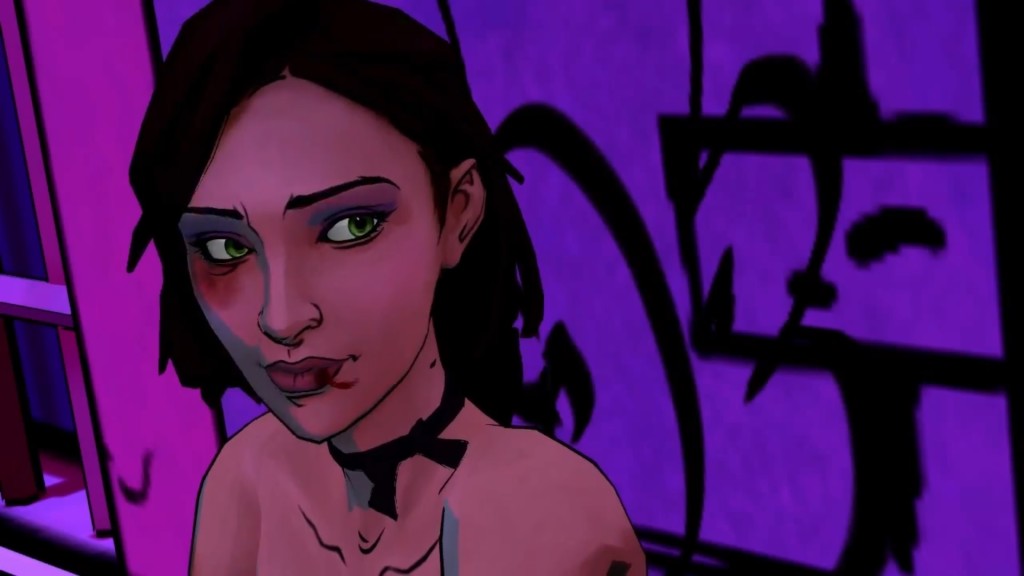
Lily’s glamour is revealed canonically in the game, but the game’s twist ending creates questions for glamour usage that is not stated outright by Telltale. The most popular theory online is that Faith glamoured as Nerissa (The Little Mermaid) or vice versa. Their lines of dialogue are strikingly similar, which causes Bigby to have flashbacks as Nerissa walks away from him in the final scene. They both ask Bigby if he likes their ribbon, which we find out later is being used to magically silence them, and if it is removed, their heads will fall off. The ribbons are lifted from the story The Girl with the Green Ribbon; in The Wolf Among Us, the original girl with the ribbon is Georgie Porgie’s girl, Vivian. They use the curse of her ribbon to create the ribbons for all of the girls who work at the Pudding & Pie night club; while the ribbons are attached, they cannot speak about their employers. Both Nerissa and Faith tell Bigby that their “lips are sealed” when he asks questions about who they work for. They also both say that he is not as bad as everyone says he is. The first theory: The “Faith was Nerissa” theory, which posits that Bigby meets the real Faith at the beginning of the game, and the head left on his doorstep was actually Nerissa’s but glamoured to look like Faith. The “Nerissa” Bigby meets is actually Faith in disguise, and she uses that disguise to escape from her current situation and fake her own death. Theory two is the opposite: “Nerissa was Faith” leans toward the interpretation that Faith was dead at the beginning of the game, and Bigby meets Nerissa glamoured as Faith. Possibly, she disguised herself to get his attention so she could drop the real Faith’s head at his doorstep for him to solve the crime and dismantle the Crooked Man’s empire. This theory states that Nerissa is then not glamoured for the rest of the game. Jeremy Gill outlines both theories extensively in his article, “The Wolf Among Us”: Who Were Faith and Nerissa?”. Both of these theories are compelling because both of the women’s origin stories focus on self-preservation, sacrifice, and transformation, but regardless of which you ascribe to, the game’s ending still sets up interesting meta-textual commentary on the Fables and their tales: Faith’s tale, Donkeyskin, is not often remembered (Bufkin, Snow, and Bigby had to look it up and read it in the business office because they weren’t familiar with it), and her death, whether it was her true death or a part of her plan to escape her circumstances, still exemplifies how necessary it is that these often forgotten stories are shared and known. Despite the deception or transformation, the underlying theme is the same: these murders would have been ignored or swept under the rug without someone placing the evidence in plain sight.
The Fabletown government is underground and secretive. They cannot tax their citizens and they cannot ask for aid from the American government, but rather, they receive donations from Fables who were lucky enough to keep their wealth when fleeing the Homelands. Because they are beholden to donors, the people with money are the ones who have the most influence. Without any stable source of income, the government cannot provide for the Fables who need help and are asking for it through the correct channels, and this broken system leads people to find alternatives to make money. Some Fables turn to the Crooked Man for loans that they are hopeless to repay, like Beauty and Beast, and others live in servitude and pay off their never-ending debt with prostitution, like the girls at the Pudding & Pie. In any case, although the system is failing them, the Crooked Man exploits and destroys the lives of those around him, and he creates more hierarchies in the community by oppressing those beneath him. At the same time, it is not difficult to see why the Fables make this decision to go to the Crooked Man. It is extremely difficult to speak truth to power, and the Fables who wait aren’t getting anywhere by sitting in a hallway just for Snow White to usher them away. One of the most vocal characters is Grendel (from Beowolf), who often berates Bigby and Snow for their failures and lack of concern for the lower class: “God fucking dammit! … Of course the dear Princess Snow fucking White is safe and sound! Where were you when we reported this weeks ago, huh? Where are you when we ever fucking need you?! If you’d given one ounce of a shit about her, about any of us, she might’ve been saved! She might’ve been cared for!” Snow is trying to make changes within the system which is a painstaking process that often yields no results, so Gren is right with airing his grievances. There is only so much intention matters when people are dying and the people who are supposed to protect you are doing nothing, or making it even worse. While Gren and Holly don’t work for the Crooked Man, and hate him because he is partly responsible for many crimes, it is understandable that some of the characters can’t afford to be idealistic or follow the rules; they’re placed in an impossible scenario with no assistance. Catching the Crooked Man does not stop the systems of poverty and oppression within the town. There is no single person to blame or take the fall for all of the societal ills, and eliminating him does not fix their broken government.
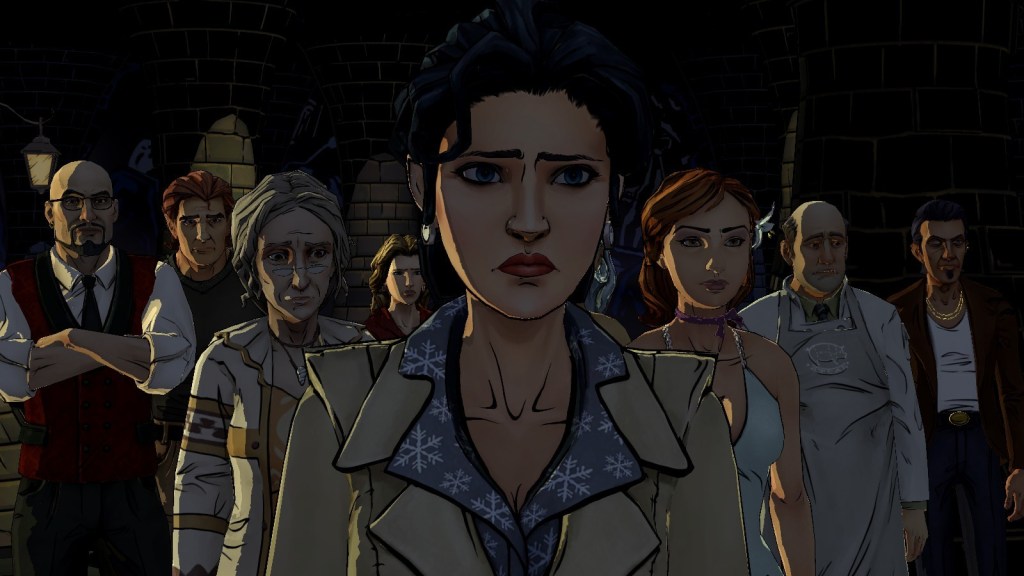
The crime within the Fabletown arises out of material conditions. The Fables all react differently and take different measures within their control when they’re unable to get access basic resources for their needs. In other words, the game provides a sociologically acceptable reason for why desperate people steal, lie, and hurt one another rather than it being inherent to their character because they’re ridiculously one-dimensional (with the exception of Bloody Mary, the Jersey Devil, and the Tweedles, but not everyone has to be a round character). This story decision is interesting because while many of the tales the characters derive from are brutal, the game chooses to draw attention to that violence as a means for survival in semi-modern times; it gives a complexity to stories and myths within the popular consciousness that are not usually complex. This narrative choice is successful at producing both ambiguity and empathy. Some of the characters do horrible things out of a genuine fear for their lives and families. Some characters want to grow and surpass their previous reputation. Others, like Tiny Tim and Flycatcher, are not involved in the murders at all, but still work for the Crooked Man and the Tweedles under the delusion that they are nice people providing them with an opportunity. On the other hand, characters also make decisions that are indefensible and evil, but that isn’t the point: the point is that you know where it is coming from, and the game depicts a complex web of criminality and morality.
Many of the Fables are concerned about their “stories” or their roles within them; their folktales are their real lives, and for some of them, the past looms over them like a shadow. Part of the Woodsman’s crisis is his insecurity at being forgotten, or even worse, having to live up the ideal person he is from the story when in actuality he did not save Little Red Riding Hood from the Big Bad Wolf with good intentions. He went to the house to rob her and her grandmother, but saved their lives for a reward instead. His tale romanticizes him as a hero when he’s anything but. Aunty Greenleaf also makes a comment on her role as the witch in these stories: “You think I like being the old woman in these stories? The men are heroes, the ladies are whores… and the old hags like me get to watch everyone they love die.” Her character arc is one of seeking control of her own circumstances; her glamour tree ties her to the Homelands, but also provides her with a means to support herself. It is clear that she is not ruthless, being the only person who wants to spare the Crooked Man at the end of the game, and she produces the glamours in order to live comfortably.
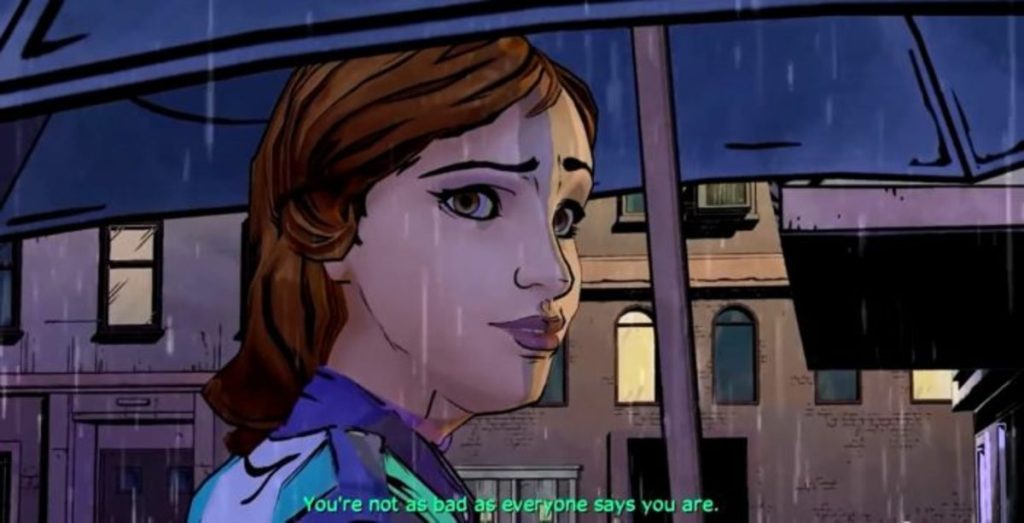
The characters being famous from fairy tales, folktale, or literature comes with another added meta-textual caveat: the player has expectations on how they will function within the narrative. For instance, I don’t think most people playing this game for the first time thought it would be possible that Snow White was the murderer, and that’s because we know her story. Her depiction here is a strong-willed, smart person who has a naïve, privileged belief in a broken system. She does most of the work for a disgusting, misogynistic employer, Ichabod Crane, who deluded himself into thinking that his objectification of her was his warped way of showing love. Characters like Bluebeard, however, draw some suspicion immediately, as he was a serial killer who preyed on his wives. He is not the culprit of Faith and Lily’s murders, but the game plays with our expectations and pre-existing morality judgments. Other tales or poems are kind of blank slates: Georgie Porgie’s character is based on four lines of a nursery rhyme, and it’s a pretty imaginative interpretation. You’re playing as a character, the Big Bad Wolf, who by all intents and purposes, was never redeemed in his story, and who has a lot to apologize for. People are afraid of him and for a good reason. He may have political amnesty, but that doesn’t erase people’s memories. Bigby is also the one upholding the system and its rules, or, at least, he can do that, if you choose to follow Snow White’s orders, so he participates in oppressing the town. These pre-existing judgments make us more likely to let our prior knowledge of the characters color our suspicions, but they also exist for the characters themselves, many of whom are living in the past and have a fixed mindset about the Fables around them. The Fables being from popular Western literary canon also has another unfortunate caveat: the game is very white. Though it is not explicitly stated, Bluebeard is racially coded as a light-skinned Black man. The game does not provide much depth to him, instead choosing to depict him as a flat character and reprehensible person. There is also Gwen, a Black woman who works at the Pudding & Pie. She doesn’t have a speaking role and doesn’t appear in the Book of Fables. Coincidentally, when telling a story about whose stories are often forgotten or overlooked, they managed to make New York City incredibly white, like an episode of a nineties sitcom.
Nerissa is correct when she states that people don’t normally pay attention to violence perpetrated against disenfranchised groups. She says that people want her and other sex workers to be silent about their hardships, and that her kind of suffering is often ignored, so she needed to send a message so that people would care about the stories of Faith and Lily. Regardless of which theory you believe, this concept is a powerful storytelling tool. Holly attempted to report her sister as missing, but she was met with paperwork, waiting rooms, and broken promises. People cared more about her sister when she was glamoured as Snow White, one of the Fabletown elite. The ribbons serve as a literal silencing tool, but all too often, the reality of what kind of violence is normalized in society is much more covert and sinister, hiding within the systems we put faith in. As Nerissa says to the Crooked Man, “You enslaved us for years, let us hear stories about what you’d do…told us we would lose everything if we stepped just one toe out of line! And we couldn’t say a word about it because of these damn ribbons! But you know what? Now it’s my turn to talk.” But the girls were also failed by their government long before the murders were committed. If you ascribe to the Nerissa was Faith theory, the Little Mermaid traded her voice for her legs, and now she has her voice back. If you think Faith was Nerissa, Donkeyskin managed to escape another oppressive scenario using her wit and deception. In any case, the curse being broken is liberating, and allows the women to have some more autonomy over their lives, even if dealing with the Crooked Man and some of his employees does not magically fix Fabletown. The game, like many murder stories, uses violence against women as a catalyst for change. No matter how subversive it is, and no matter how complex the social commentary, the game still begins with a woman’s head on a doorstep, and uses her body as collateral damage to tell a story. Although the game creates this meta-textual commentary, it still participates in this long-held trope of the horror genre. The personal is political, and death is often politicized. There are people whose suffering and deaths are ignored or even justified when it shouldn’t be so easy to blame them for their decisions within a broken system. They are deserving of resources, justice, and empathy like everyone else. In a game where the characters are from stories we all know, Nerissa exposes an unsettling truth about which stories we choose to prop up and glorify, and how it is often easier for us to simplify people’s choices into archetypal roles rather than providing a nuanced perspective on where crime comes from. Just like the rest of the issues presented in The Wolf Among Us, there are no easy, definitive answers that I can give—only an interpretation.


Leave a Reply