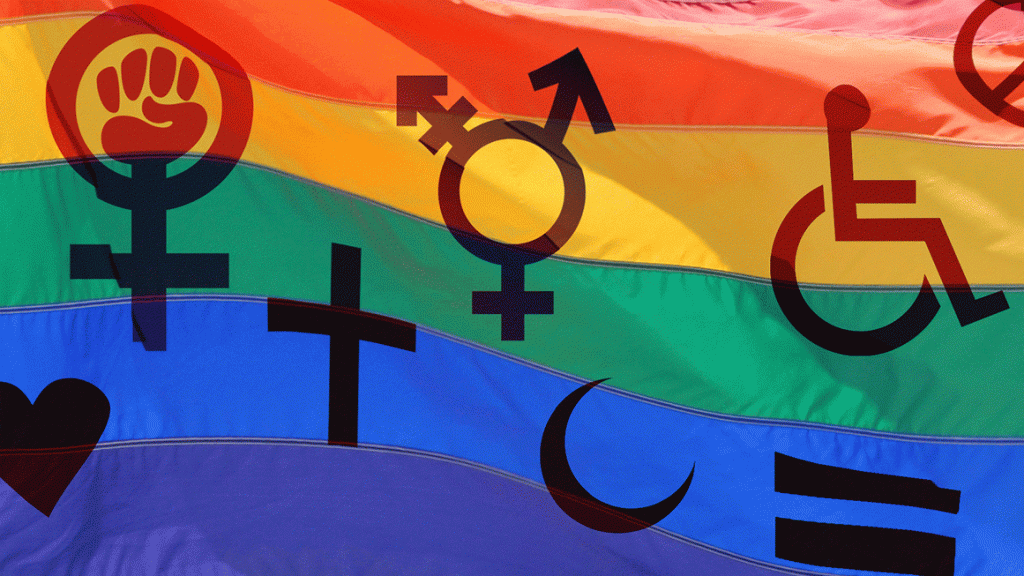
In A Cup of Water Under My Bed, Daisy Hernández writes about her experiences growing up in a Cuban-Colombian family from New Jersey, tracking her life through the ways in which her identities weave together: she is a bisexual, bilingual, second generation immigant who finds herself caught between her family’s cultural heritage and her life as a queer feminist writer. Likewise, in her memoir, Hunger, Roxane Gay discusses her intersectionality in being an overweight, bisexual, woman of color. Her Haitan parents and middle-class upbringing play a significant role in her grapplings with her body and her trauma. Both writers’ identities set them apart from their white and often male heterosexual counterparts in academia and the workplace. Their queerness comes not only from their sexualities, but also from their intersectionality as a whole–they are between worlds, culturally and socially. That feeling of not being able to fit into any one box, whether it is just ‘woman’ or ‘person of color,’ enables them to recontextualize their lives within the framework of intersectionality; Hernández is not just a woman, but a woman of color, and she is not just a woman of color, but the daughter of working class immigrants. Gay is also a woman of color, and her experiences are dictated not only by being a Black woman, but by being a Black woman whose body takes up space and is subjected to public ridicule. Their lives and experiences are linked to the multiplicity of their identities, and they derive meaning from their memories with trauma and discrimination to create a powerful, compelling and cathartic form of activism that values the voices of those who stand within these intersections.
In her Ted Talk entitled “The Urgency of Intersectionality” Kimberle Crenshaw discusses two poignant themes: intersectionality and storytelling. She draws our attention to the exorbitant amount of Black women who are murdered by the police, pointing out how although police brutality against African-American men is a pressing issue that needs to be addressed, the media often overlooks how many African-American women, who stand within the intersection of gender and race discrimination, are killed by the police. Crenshaw talks about the concept of intersectionality as a framing in which we can view the world. Police brutality against women and African-American men does not necessarily encompass the intersection of simultaneous oppressions that women of color face when they are threatened with violence. The framework of intersectionality enables us to look at racism and sexism, not as two entirely divorced concepts, but concepts that can overlay and complicate one another. Crenshaw’s Ted Talk is an extremely powerful and thought-provoking meditation on how Black women’s stories are forgotten, their names hidden from the public discourse, and their lives lost in the shadows of systemic racism and sexism. Crenshaw posits the importance of story-telling as the difference between life and death; there is so much power in the words and recognition of these women’s deaths and the political and social repercussions of them. All she asked of her audience to do was simply remember the names of the women impacted by this violence. Although she does not explicitly discuss memoir writing, her points about oral story-telling and media coverage are applicable to discussing intersectional writers. In essence, Hernández and Gay are asking us to remember their names and stories, forging a link between the reader and intersections of oppression that are often overlooked.
In her debut memoir, A Cup of Water Under My Bed, Daisy Hernández addresses biphobia, classism, racism and sexism. She offers a nuanced and complex story of her upbringing and education, her family and cultural heritage, and her experiences as a writer. Hernández starts her book by revealing her writing process and her need to testify her experience. She tells a short story about how a town official came to her childhood home in New Jersey. While scribbling notes about the structure and integrity of the house, he muttered “this house should be condemned” (xi). Hernández remembers her mother asking her what the official said in Spanish, but she does not tell her. She writes:
I was about twelve at the time and I didn’t know the Spanish word for condemned. I didn’t have a word in our language that would say, This photograph on the wall, this pot of black beans, this radio we listen to each day, these stories you tell us–he’s saying none of this matters. It should not only be thrown away but bulldozed. (ix)
In this strong introduction to her memoir, Hernández is already writing in terms of intersectionality; her family stands between the intersection of discrimination based on class and race. This town official does not value their culture on the grounds that is it a non-white culture, but also because their home is tiny. She resolves to tell her story to resist this mentally–to ground her life within a testimony of her memories, family and intersectionality.
An ongoing theme throughout Hernández’s memoir is her accessing the cultural and social divide between her and her parents. She realizes, through trying to educate her mother on gender issues and racial issues, that her mother might not have the words to articulate her own intersectionality, but she has her lived experience, which binds them together: “I explain […] ideas of the borderlands, of living “in-between” as feminists, as Colombianas, as women who belong to more than one land and one culture. We are neither here nor there […] My mother nods […] and the idea begins to bloom in me: my mother already knows this” (31). It is clear that intersectionality and feminism gave Daisy Hernández a power to harness her words and to use them to empower others, but in this moment of reflection, she begins to see that her mother had known all along what it was like to stand at the intersection of race, gender and class.
When facing discrimination, Hernández discusses bigotry as a complex network of interweaving oppressions. For example, her experiences with biphobia and feminism are intrinsically linked to her family and cultural identity. In an article entitled “Coming Home to the Motherland and Coming Out: A Cup Of Water Under My Bed Gets Translated to Spanish,” she says: “My mother had told me when I was twenty-five that Colombia didn’t have gay people. She didn’t say it in a mean way. That sort of thing just didn’t happen in Colombia, she said.” Likewise, within the memoir, she paints this portrait of her aunt, Tía Dora, as a complex figure who survived poverty, sickness and hardship. Tía Dora experiences racism and sexism, but regardless, she is homophobic. Despite being told by her family that there is no place for queerness in her culture, Hernández ultimately connects with Colombian women who are queer through writing her memoir: “Even when they weren’t queer themselves, they knew someone who was, someone they loved […] Here were women, whose faces reminded me of my own mother, reminding me that books still inspire the most intimate of connections.” Hernández reflects the importance of intersectionality–her mother and aunt come from similar walks of life, and yet, their hatred and ignorance functions as a mirror image of the discrimination that they have faced in other aspects of their lives.
Although it is clearly stated that her aunt is homophobic, there are shades of assumptions specifically linked to biphobia in her assessment of her niece. Tía Dora speaks to her again when she is dating a man, as if to imply that her time with women was a phase. There’s a prevalent idea that bisexual women need to choose a binary sexuality when they settle down with a partner. This interpretation of bisexuality as being not real, or being a phase before one chooses, adds another dimension to intersectional identity. “I am meeting lesbians, but I am not one of them. I still find men attractive; it is that I am thinking of women in a new way” (93). Because bisexual women can pass as heterosexual when they are with the opposite gender, there can sometimes be less sympathy and acceptance within queer communities and spaces for their identity. Likewise, by not being heterosexual, bisexual woman continue to be stigmatized and regarded as an ‘other’ to straight people. Being bisexual is yet another instance of how Hernández is “neither here nor there.”
Hernández closes her memoir by mediating on her time as a writer for The New York Times in comparison to her work in an intersectional femininst magazine, ColorLines, and how sexism and racism affected her in academia and the workplace. “The meetings take place in a conference room. […] They file in one by one, welcome me, make jokes about this and that, and it begins to dawn on me that they are regular white people” (151). When she finally gets the job that she worked her entire life to get, it becomes clear to her that you do not need to be special to work for The New York Times. Growing up bilingual, she worked hard to perfect her English in order to get a job and be successful; her relationship with Spanish and her culture was often strained and complex in order for her to do so. This illusion of meritocracy is shattered as she realizes that the white people who work there are ordinary, while she needs to be twice as good to get a seat. They are not ethereal gods and goddesses as she has envisioned growing up. The world is an unfair place where her identity is easily overshadowed, erased and forgotten. “As much as I want to leave, I can’t. This is my big opportunity, the moment I have been preparing for my whole life. People like me, from the community I come from, we don’t just get to work at The New York Times” (159). While working there, she is not taken seriously when she wants to write about racism or immigation; rather, her white male boss challenges her perspective, preferring her to write fluff pieces. In contrast, her experience with ColorLines is akin to a small family. She writes about what she is most passionate about: the stories of women who are often overlooked and abandoned by society, “who need to tell their children’s nightmares, their own depressions, their rage, and how the future feels like a page ripped from a book” (175). By writing her memoir and working for ColorLines, she shifts from working within white dominated spaces and proving herself as worthy of those spaces to elevating the voices of other marginalized women. She stands in the intersection of racism, sexism and classism. She is not taken seriously by The New York Times, but neither are the stories that she wants to write about, or the people in them. In being ignored, she realizes that being recognized for her work within a white dominated space is not her liberation–her voice is her liberation and her writing is her means of consolidating all of her identities into her own narrative on her terms.
Likewise, Roxane Gay’s memoir, Hunger, is written using an intersectional framework; her family, race, culture and womanhood are all viewed through the context of her body and her weight. In tackling the cultural heritage of her parents, she reveals their internalized fatphobia, even though she admits that their concern for her weight is rooted in love. Gay writes about how her trauma of being raped at twelve years old by a group of boys in the woods caused her to eat and become fat, making her body a fortress to protect herself from harm and violation. Of her family, Gay explains: “We have a shared history and we do not […] There is a great life we share and the more difficult parts of my life we do not, that they know little about” (25). While Gay loves her parents and even says “everything good and strong about me starts with my parents,” (29) she still finds it impossible to open up to them. They do not understand why she gained weight, but they offer advice to her that they think is helpful; they do not give up on her, even if their concern is sometimes overwhelming and not helpful at all. With her family, Gay stands in an intersection. Her trauma and silence is linked to her shame and fears rooted in rape culture because she did not think that anyone would believe her or fight for her. She links her experiences as a woman in her body before her trauma to her experiences as an overweight woman in American culture after her trauma. She protected herself from being hurt by others, but in the process, made herself more vulnerable to attack and judgment. In writing her memoir, and in accessing the multiple intersecting parts of her life, Gay confronts her trauma, and as a result, her family finds out about all of the secrets and feelings that she was hiding for many years from them.
Roxane Gay discusses how racism and sexism affect her throughout her memoir, especially in how she is viewed in regards to her gender expression:
My fat body empowers people to erase my gender. I am a woman, but they do not see me as a woman. I am often mistaken for a man. I am called “Sir,” because people look at the bulk of me and ignore my face, my styled hair, my very ample breasts and other curves. It bothers me to have my gender erased, to be unseen in plain sight. I am a woman. I am large, but I am a woman. I deserve to be seen as such. (233)
They see her as being overweight, as if being overweight, in general, encompasses all of her identity. She also contextualizes her commentary on broader gender and racial issues with her body and weight. Her feminism is inseparable from her body and how people view her body; while she comments on how women, in general terms, have their bodies on display for public commentary and ridicule, her body is the subject of harsher, more invasive commentary and ridicule.
When you’re overweight, your body becomes a matter of public record in many respects. Your body is constantly and predominantly on display […] Regardless of what you do, your body is the subject of public discourse with family, friends and strangers alike. Your body is subject to commentary when you gain weight, lose weight or maintain your unacceptable weight (110).
Society’s obsession with food and weight loss is an issue across the board, but it is an issue that is disproportionally felt by women, whose bodies are already on display for public approval and consumption. Women of color experience fatphobia, racism, and sexism; the exploitation and objectification that they are subjected to is a form of violence and hatred that is unique to their intersecting identities. For example, the pop star, Lizzo is a beacon of body positivity and feminism. She is often met with vitriol by critics who claim that she should not wear tighter fitting or revealing clothing because of her weight; she is also met with misogyny and racism that is exclusive to women of color. In her article, “Truth Hurts: Lizzo, Black Women and Weight Stigma,” Joy Cox, a body justice advocate who hosts a podcast focusing on the lived experiences of Black women, writes:
Twerking on stage with skill and finesse, Lizzo exudes confidence with a surety of her body’s abilities. She is not reminiscent of the fat Black mammy whose main purpose in life was to be the caretaker of others. Nor is she the depiction of the sassy fat Black woman who is full of strife, using deception to get what she, in society’s eyes, could not otherwise qualify for. Quickly, Lizzo dispels any idea that what she does is a minstrel of sorts. Rather, she puts on a show relative to that of her smaller counterparts, obliterating the myths steeped in weight stigma that one cannot be fat and active, or fat and skillful, or fat and confident. Furthermore, Lizzo has no problem sharing the stage with other fat Black dancers, reinforcing the premise that we are a community of many, and she is not alone. (Center for Discovery)
Lizzo, similarly to Roxane Gay, shares this intersection of competing oppressions and discriminations that culminate in harmful stereotypes about overweight Black women; the only difference is that Lizzo is more so in the limelight. Her body is the topic of think-pieces and diatribes, not only in personal conversations between friends or strangers that see her in public, but the entire world and internet.
Towards the end of Hunger, Gay reflects on how she has structured her life up until the memoir was published:
I am taking small steps toward the life I want. For the past twelve years, I have lived, rather unhappily, in rural America. As a black woman, this has been trying, at best.
[…] I’m afraid to live in a city where, at least in my mind, everyone is thin, athletic, beautiful, and I am an abominable woman. (268)
Living in a small town in rural America compounds all of these prejudices; she is hypervisible in her race because there are more white people where she lives, but she feels oddly safe in this visibility because “We were so far North that my blackness was more a curiosity than a threat” (268). She resolves, at the end of the chapter, to not hide from the world anymore, regardless of her race and her body. Like Daisy Hernández, Roxane Gay writes her memoir as a testimony for her own life and story, and she does so within the framing of intersectional identity: “I am using my voice, not just for myself but for people whose lives demand being seen and heard” (277). Her writing is not only for herself, but for the people who feel as though they are invisible in their hypervisibility.
In her article, “Mapping the Margins: Intersectionality, Identity Politics, and Violence against Women of Color” Kimberle Crenshaw indicates that “the problem with identity politics is not that it fails to transcend differences, as some critics charge, but rather the opposite–that it frequently conflates or ignores intergroup differences” (1242). Crenshaw argues that while identity politics has been a source of strength and togetherness for marginalized people, it can also be problematic, as it prioritizes some identities over others when entering a political landscape:
Although racism and sexism readily intersect in the lives of real people, they seldom do in feminist and antiracist practices. And so, when the practices expound identity as a woman or person of color as an either/or proposition, they relegate the identity of woman of color to a location that resists telling. (1242)
This “location that resists telling” explicates the importance of intersectional memoir.
Intersectionality is so important in bringing people together to form coalitions against bigotry and hatred, and memoir is a way of “telling” these inner truths about intersectional lives that are often resisted or erased. In writing this, and in reading the words of women who are marginalized in ways that I am not, I feel that I must recognize the differences between our experiences as well as our similarities. As Crenshaw notes, identity politics can be flawed in that it has the capacity to erase these differences between groups, and these differences are important in dictating experience. Being a bisexual woman, I understood and related to many of Hernández and Gay’s struggles with biphobia and sexism. Flipping through the pages of these women’s lives, I found catharsis, strength and solidarity with their battles against bigotry in tandem with my own. I understood how it felt to be ignored in a workplace or academic environment by men, but not entirely in the same way. I also feel the pressures to conform to a certain weight or beauty standard because I am a woman in America. However, I cannot relate to their experiences as women of color, or as women who stand between an intersection of competing oppressions. To overlook that difference or to act like it does not exist because we are all women would be unforgivable. While they deal with racism and sexism in the workplace, I can access my interactions with patriarchal institutions as being biased against my gender, and that is all. That is to say, I am white, and by having whiteness within my intersection, I have a moral responsibility to acknowledge the privileges that whiteness grants me in society, and to recognize that these privileges should not exist. In order for the world to be a better place, white people need to abandon this framework of ‘whiteness’ and all the benefits that go along with it. That means that when discussing sexism, we cannot overlook how sexism impacts other women differently. In writing a paper about the importance of intersectional identity, the irony is not lost on me that I do not have the authority to discuss every facet of their lives. I do not want to pretend that I do. I cannot give their words the justice they deserve. I cannot position myself as speaking over the women of color who I am quoting and whose work I respect and admire. I have to strike a delicate balance in which I analyze their work without parroting their experiences succinctly or at all. Intersectionality is bigger than myself. Because whether or not white people fight against white supremacy, or we are silent and complicit in white supremacy, we benefit from it. White women can choose, as many of them have, to care selectively about feminism in regards to white women and white women only, or cisgender women and cisgender women only. They have, time and time again, asserted the little power they have within these patriarchal institutions to choose whiteness over womanhood. In many cases, when faced with identity politics, white government officials and celebrities have chosen upper-class solidarity over womanhood. They have chosen to care only about how oppression affects their position as a person who is socially marginalized in one aspect of their identity, while ignoring white supremacy or class supremacy entirely. This process is how, in my own estimation, American Liberal media outlets and corporations, such as the New York Times, as evidenced by Daisy Hernández, are entirely out of touch with the experiences of people of color, immigrants, and the working class. While they position themselves as champions of truthful journalistic integrity, they choose which stories to cover in their paper and which to ignore, just as the white men and women within those boardrooms spoke over her rather than valued her insight. In forgetting how some of us benefit from the current status quo or systems that are in place, we are forgetting how we are all standing in our own intersections, and moreover, how our identities shape our experiences. Only by recognizing hierarchies can we dismantle them.
In her paper, “The Transformation of Silence into Language and Action,” Audre Lorde wrote: “But for every real word spoken, for every attempt I had ever made to speak those truths for which I am seeking, I had made contact with other women while we examined the words to fit a world in which we all believed, bridging our differences” (41). All women, across all intersections of identity, Lorde posits, are in a war against silence. We are all fighting, together, this battle against being erased and having our stories be forgotten. “The women who sustained me […] were Black and white, old and young, lesbian, bisexual, and heterosexual, and we all shared a war against the tyrannies of silence” (41). Specifically, Lorde talks about how Black women are highly visible and scrutinized, but they still have to fight for visibility within the women’s movement. Lorde opens her paper by saying that she stands before the reader as a Black lesbian poet, asserting her own voice and identity in this battle against silence. She constructs this paper around her experience, but her call to action is based on finding common ground regardless of identity, and that common ground for women is this fight for our names to be remembered. Our voices need to break through while we are alive because in death, there is a final silence: “the machine will try to grind you into dust anyway, whether or not we speak.” Women were not meant to survive and be remembered under this tyranny of silence, especially in America, where racism as well as sexism is a constant reality for Black women. There is a power in resisting this silence, or in forging your own path and solidifying your narrative, especially in writing memoir. There is a power in visibility and in speaking out against oppression because silence only helps those in power. Hernández and Gay both have similar narrative arcs within their respective memoirs; they both have to contextualize all of the facets of their identity within the framing of intersectionality, and in doing so, they use their voices to speak truth to power, and to heal from the trauma in their pasts. These memoirists embrace the simultaneous, intersecting moving parts of their lives; through their memoirs, they seek to find belonging in their multifaceted identities, forming connections between the many worlds and spheres they occupy through writing and activism. Like Hernández says in her introductory chapter, “Nothing is more vulnerable than the words in our mouths because nothing has more power” (xii).
Works Cited
Cox, Joy. “Truth Hurts: Lizzo, Black Women & Weight Stigma.” Center for Discovery: Eating Disorder Treatment. Available at: https://centerfordiscovery.com/blog/ truth-hurts-lizzo-black-women-weight-stigma/
Crenshaw, Kimberlé. “The Urgency of Intersectionality.” Ted. YouTube. Dec 7, 2016. Available at: https://www.youtube.com/watch?v=akOe5-UsQ2o
Crenshaw, Kimberlé. “Mapping the Margins: Intersectionality, Identity Politics, and Violence Against Women of Color.” Stanford Law Review, Vol. 43, No. 6, (July 1991), pp. 1241-1299. JSTOR. https://www.jstor.org/stable/1229039.
Gay, Roxane. Hunger. Harper Collins, 2017.
Hernández, Daisy. A Cup of Water Under My Bed. Beacon Press, 2014.
Lorde, Audre. “The Transformation of Silence into Language and Action.” Paper delivered at the Modern Language Association’s Lesbian and Literature Panel, Chicago, Illinois, December 28, 1977.


Leave a Reply