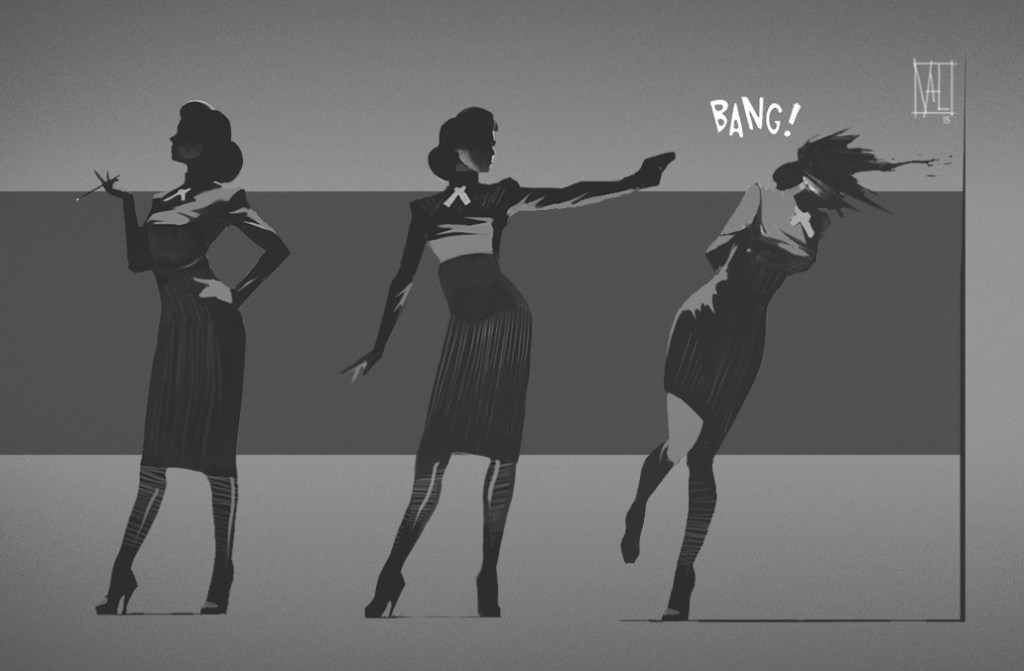
William McIlvanney’s Laidlaw (1977) and Louise Welsh’s The Cutting Room (2002) use the deaths of beautiful, young women as political and social commentary. Both of these contemporary Scottish crime novels delve into themes of gender, victimhood and violence, showing how an oppressive, patriarchal society allows women’s bodies to be brutalized and objectified because of bigotry, ignorance and sexism. Despite being published twenty-five years apart, the novels share similarities in how they use violence as a catalyst for social upheaval and change, reflecting upon society’s flawed, dark criminal underbelly to do so. However, these novels show a duality of progressive representation: they give a voice to victims in their stories through their other characters who react to the murders and are desperate to seek justice, and yet that voice is refracted and translated by their male leads instead of their victims’ perspectives. In Laidlaw, Jennifer Lawson’s death functions as a violent act that could have been prevented if not for bigotry, specifically, homophobia, and yet her silence is deafening and illustrates how victims of interweaving systems of power are given no room for closure or a personal narrative. Similarly, the woman in the snuff photo in The Cutting Room symbolizes the ways in which women are objectified in society. Her murderer mutilates her body in a disgustingly grotesque way and the novel critiques that objectification, but her death renders her to be what he saw her as all along: an object for sexual gratification.
Throughout Laidlaw, death and violence occur as a direct result of societal oppression. McIlvanney shows that those who hold power can use language as a means of reinforcing social norms. A young girl named Jennifer Lawson is brutally murdered by a homosexual boy named Tommy Bryson because he struggled with his sexuality: “‘He wouldn’t come all the way out. A lot of people can’t. He still wanted to be straight. Heterosexual’” (229). Tommy murders her because he cannot be himself in Scottish society, and Jennifer hides her whereabouts from her family because her father does not want her dating a Catholic boy–both instances are linked to how hatred inadvertently forces the hands of those who are marginalized into decisions where they can exorcise some kind of control through violent action. The interweaving layers of miscommunication and ignorance paint the landscape of Laidlaw, in which the titular character must cut through all of that bigotry and hatred to form a conclusion about humanity as acting, not monstrously, but out of revenge, desperation, and self-interest. Laidlaw recognizes that Jennifer would not have been murdered if not for homophobia, and she would have felt safer and more trusting in her family if her father accepted other religious faiths and worldviews. Culture can impact a person’s actions and feelings about themselves and others. This beautiful, young dead girl acts as a symbol of innocence to which all of the other characters must expunge their sins and mistakes. Her body is collateral damage to the moral lesson of the novel.
Jennifer Lawson, despite being as voiceless as the woman in the photograph in The Cutting Room, is given a name. She is given a family history, a motive (although not coming from her own mouth), and a story. Although Laidlaw has chapters that follow the perspectives of most of the living characters, Jennifer Lawson does not have a chapter before her death; her personality, emotional reasons for leaving her parents in the dark, and whereabouts are all told from the perspectives of her family, friends, murderer, and those who wish to avenge her. Jennifer’s voice dies with her, but her body continues to provoke reactions: “The girl’s naked body lay on a metal table with raised edges. The man was washing it. […] ‘Been an attractive lassie,’ Alec said” (43). The man washing Jennifer’s body, someone who is accustomed to this kind of work, remarks upon her looks, which is grotesque and reveals women’s objectification, even in death. When Jennifer’s father, Bud Lawson, sees her, the narrator remarks that “[Jennifer’s] face was completely composed, the mouth held gently shut by the cloth beneath the chin. Her youthfulness was blinding. Framed in white, she was like an involuntary nun.” (44) She is described with such youth and innocence; there’s a fascination with her purity here, made apparent by the words “youthfulness,” “white” and “nun.” This characterization of Jennifer as being pure and angel-like makes her into an infallible figure rather than a human being; it’s a ‘nicer’ way to objectify a person, but nonetheless, it creates a mythology, making her ethereal instead of identifiable, relatable, or human. Ultimately, while McIlvanney sought to illuminate society’s flaws and challenge systems of power by giving a voice and story to victims of oppression, it is clear that Jennifer Lawson’s body functions as a plot device within the dark, gritty Scottish world of Laidlaw. Because Laidlaw was published twenty-five years before The Cutting Room, we can analyze the novel as a foundational text in contemporary Scottish crime fiction.
Having a woman victim is a trope that McIlvanney utilizes and establishes in Laidlaw that is also utilized and established, albeit differently, by Welsh in her novel. Like the aforementioned Jennifer Lawson, Welsh also writes about a beautiful, voiceless dead woman in her novel. Although the pieces and plot points change, this vision of the victim as a woman and her body as an object in an investigation that drives the plot of a male protagonist has remained consistent. However, there are some key differences between the two stories. First and foremost, The Cutting Room is written by a woman, specifically, a queer woman, and unlike the masculine hard-boiled detective Laidlaw, her main protagonist, Rilke, is a gay man. Where the murderer in Laidlaw was a gay man, in The Cutting Room, he is our detective figure, trying to piece together the identity of his mysterious woman. Both of the texts play with this idea of queerness as a focal point; McIlvanney wrote during a time where is it was still illegal to be homosexual in Scotland, but Welsh wrote during a time where society was more accepting of gay people, but there was still a lot of stigma, misinformation, and lack of representation, especially amongst protagonists in crime fiction. While McIlvanney tells a story of the oppressed minority as a killer that the protagonist must find, Welsh frames her story around her protagonist as an ‘other.’ Rilke is someone who is not understood or sympathized with by all, but it is his story, nonetheless. She creates this shorthand of experience where Rilke can identify, whether he does so verbally or not, with those on the fringes of society–the people who are forgotten, ignored, or dehumanized like the woman in the photo. So, therein lies the duality of interpretation; we have two authors that are breaking the boundaries of tartan noir by including queer characters who are notable in their identities and their stuggles in their identities, but they still have these dead beautiful women splayed in the foreground of their plots.
In his article, “Aesthetic Depersonalization in Louise Welsh’s The Cutting Room,” Gavin Miller discusses the objectification of women’s bodies in crime fiction as a trope of the genre; he notes that within Welsh’s novel, there is a process of depersonalization in which the reader is meant to look at the murdered woman’s body through another aesthetic object: the crime scene photos. By rendering her an image of a “physical-chemical system or as an organism” within the text rather than a living, breathing person, “[her] corpse is seen or read not as referring (albeit fictionally) to the brutalized remains of a person, but as an aesthetic object in itself” (76). Miller argues that Welsh’s thesis in The Cutting Room is to critique this shift in perspective: “we must see it partly as a commentary upon the ease with which we can adopt a depersonalizing stance that is aesthetic in its attitude” (76). The camera lens forms the separation between the woman’s corpse and Rilke, as well as the length of time between when the picture was taken and when he discovers it. There are so many varying degrees of separation between Rilke and the woman in the photograph, and yet, he is determined to find out who she is and whether she is authentic; he is determined to close the gap formed by time and medium, unwilling to look at her as a relic of the past or an object for sexual gratification. He wants to attach a name to her–to uncover the story of the person that she was. “The world of objects and people. The black and white basement where the girl lay was in the past. I could see her eyes, her torn throat, but I couldn’t reach through the celluloid to touch her” (132). This world of objects and people is the space that Rilke occupies. He determines the value of objects, but he cannot determine the value of people, especially when those people are supposed to be positioned as objects. This membrane between the photograph world and the reality that Rilke inhabits becomes visceral when he finds the bracelet that the woman is wearing in the picture amongst McKindless’ random knick-knacks. He holds one of the objects in the photograph in his hands, and the crime is made tangible. It is no longer merely an aesthetic or abstract object.
In the Edinburgh Companion to Twentieth-Century Scottish Literature, Ian Brown and Alan Riach argue that Louise Welsh defies crime fiction conventions by making “the young woman in the snuff photograph and her forever-muted agony” (196) a means to find truth, rather than focusing, as stories in the genre often do, on finding a culprit, or as Brown and Riach refer to it as, a conventional whodunit. The revelation that Mr. McKindless is really alive and making moves within the undergrounds of society is less revelatory to Rilke in the climax of the novel than his obsession with uncovering the woman’s identity, and the fact that he never finds out who she is. According to a quoted interview with Welsh, “the mechanics of crime fiction is not what she is primarily interested in” (197). Welsh says, “I dislike when a murder is somehow just a prop” (197). Like I mentioned previously, McIlvanney uses Jennifer Lawson’s body as a means to kickstart the story in Laidlaw, but it must be noted that in making the woman in the photograph an actual prop (an aesthetic object), Welsh is also calling attention to how disgusting this crime trope is. She is darkly satirizing the use of women’s bodies as mere props or plot devices. And while the murder itself draws our attention to the ways in which we so willingly accept objectification, it is hard to deny that in making the victim of this crime a young, beautiful woman, Welsh is still playing with pernicious tropes within crime fiction.
Brown and Riach continue in their analysis of The Cutting Room by noting that the photograph itself is staged like a panopticon–a metaphor for imprisonment– “The eye, and its appendages (mirror sunshades, camera, video camera, photocopying machine) cannot distinguish between fake and reality, in the same way that the photograph of the tortured woman seems to allow blood seepage to contaminate the real world” (198). Perhaps, we can read Welsh’s panoptical photograph as an added layer to the visual metaphor of her criticism of the trope; the woman in the photograph, as a voiceless victim without a name or identity, is stuck in the past. Her humanity is refracted by all of these added elements (the camera, the mirror shades, etc), and yet, we are implored through Rilke’s obsession to look at her as a real human being whose story needs to be told no matter how long ago her death transpired. She is a prisoner of tartan noir’s writing conventions as much as she is a prisoner within the misogyny that produced a man like McKindless.
The use of objects is also a major theme within The Cutting Room. As Rilke’s occupation is an auctioneer, it is his job to place value onto objects and to sell them to the highest bidder. When Rilke takes the disturbing photographs of the woman to a criminal who runs a pornography studio named Trapp, he offers to purchase them from Rilke to put his mind at ease. Trapp also claims that the photos are staged and that the woman in them is wearing makeup: “What you really want to know is was a young girl murdered for sexual gratification and her corpse photographed?” (72) he asks, to which Rilke responded affirmatively. “I would say almost certainly not. […] You’re disappointed! I have spoilt your mystery. Okay, how can I be so sure? For the reason you are sure they were taken by the same person. Professional experience. Many people fantasize about sex and death” (72). This fantasy of sex and death, he mentions, is intrinsically linked to the human experience. “The association is old as time. Repeated over and over, in art, literature, cinema, mythology even” (72). Trapp places a monetary value on the photographs, adding another layer of depersonalization. He also attempts to normalize, in his rhetoric, beautiful women as alluring even in death. Whether or not the photos are genuine or staged, the woman within them is, nonetheless, an aesthetic object for consumption. There is a market for these kinds of photographs.
Welsh draws a comparison between the woman in the pictures to her living character, Anne-Marie; Annie-Marie makes her money by posing for pictures. She poses in different, tantalizing outfits and in the nude. Whenever she strips, she does so behind a curtain. She gives the men who take her photograph Polaroid cameras so that she can have a sense of control over what they do with her image. She does not speak with her clients because “I’d lose power over them if I spoke. I’m a fantasy object. The minute they realise I’m a real girl I’ve blown it” (89). Anne-Marie wields a power in her sexuality, using men’s perceptions of objectification against them to make some money. She is aware of the illusion that she is selling, and she profits from that illusion. And yet, it is revealed later in the novel that Anne-Marie came into contact with Mr. McKindless and he asked her to pose for him with lilies as if she were dead. He even asked to cut her, and she almost let him do it, basking in a moment of strange and embarrassing arousal. She almost lost control. Mr. McKindless goes back to Anne-Marie at the end of the novel and she kills him, taking that control back from him, once and for all. Where she could have been killed, she becomes the killer.
Anne-Marie poses as an aesthetic object for men, but there’s an uncertainty as to where the illusion begins and ends: how is her body any different to these men, than the woman who was mutilated in Rilke’s mysterious photograph? Anne-Marie and the woman in the photograph reveal this process of depersonalization; Welsh peels back the curtain, highlighting the process by which these photographs happen, and how the images within them cannot be controlled or contained. When McKindless takes a photograph, this process of transforming a woman into an aesthetic object is replicated for his pleasure. Like Miller suggests, it is the ease in which we slip into this mindset of seeing women as objects that Welsh is critiquing. The Cutting Room, however, despite being written by a woman and pointing out sexist ideologies around objectication, is not immune to reproducing its own problematic tropes from the crime genre. Drawing a comparison between Anne-Marie and the woman in the photograph brings our attention to the grotesque nature of depersonalization, but Anne-Marie does not entirely reclaim her sexuality and agency because her control is initially ripped from her. McKindless used a digital camera rather than a polaroid, she acquiesced to him meeting her alone at her apartment rather than in a controlled setting where she would be protected by her brother, and she spoke to him, shattering that illusion that she was just an aesthetic object. Regardless of whether that spell was broken for him, he treated her like an object anyway, revealing that she never had power over how people perceived her. While she thought that she could profit off of this illusion, ultimately, she is the one who is fooled into thinking that she is immune to patriarchal oppression. She underestimates McKindless’s inability to see her as a human in the first place.
Regardless of Rilke’s crusade for justice for the woman in the picture, she is still a mystery at the end of the novel; much like Jennifer Lawson, she does not have a voice or a chapter of her own. Her voice is revealed in her silence and what her silence represents to the narrative. That silence–that lack of agency–is what both authors are critiquing, but they are also replicating. In this way, Welsh’s introduction of Anne-Marie as a foil to the woman in the photograph shows how history does not need to repeat itself, but she can not simply stand in or erase that a woman was brutalized because she is not the same woman. By looking at Laidlaw and The Cutting Room, we can see how this trope of the bloodied, victimized woman has shifted over time, and how the other moving parts in the novels allude to shifting perspectives in terms of Scottish identity, gender and sexuality. In her essay, “Bloody Women: How Female Authors Have Transformed the Scottish Contemporary Crime Genre,” Lorna Hill writes:
Over the past thirty years, women writers have overhauled the traditionally male dominated genre of crime fiction by writing about strong female characters who drive the plot and solve the crimes. Authors including Val McDermid, Denise Mina and Lin Anderson are just a few of the women who have challenged the expectation of gender and genre. By setting their novels in contemporary society they reflect a range of social and political issues through the lens of a female protagonist. (52)
Although Hill focuses more so on women authors who have female protagonists solving crimes, she notes that authors like McIlvanney and Welsh set the stage in challenging aspects of Scottish society. Their contributions to crime fiction enabled female writers to respond to these tropes and conventions by making even more transgressive stories where women are empowered. Laidlaw and The Cutting Room are seminal texts, but it is imperative that when comparing these books within the context of crime fiction to share other writers whose work takes this progressive attitude a step further still. The women mentioned, McDermid and Mina, center their stories around female journalists instead of victims, reclaiming their autonomy within a once evidently patriarchal genre.
As noted by Glenda Norquay in The Edinburgh Companion to Scottish Women’s Writing, genre fiction, specifically crime fiction, arose as a “significant form for investigating the state of Scotland” (131) and often a “masculinized world.” Like Lorna Hill, she explains that though the genre was catapulted into the mainstream by McIlvanney, women writers have taken up the helm in writing detective fiction to challenge societal and cultural notions of gender and identity. The female characters in Laidlaw are few and far between (there’s a failed marriage and dissatisfied wife looming in the background and Mrs. Lawson and Jennifer’s friend may have broken the case and their silence in talking about Jennifer, but they do so as blubbering incoherently as the men in the story overlook their waning emotions). There’s a stark contrast between masculinity and femininity within Laidlaw that is much less distinct in The Cutting Room, where Welsh even includes characters who cross-dress and experiment with the malleability of gender norms. It seems that while McIlvanney uses tropes and genre conventions to paint a larger tapestry of challenging society, he still falls back on and relies on those conventions in writing a hyper-masculine hero who must save the day by finding the killer of a bloodied and beautiful woman. Welsh, on the other hand, subverts many of these tropes, making a complex critique of our perceptions of women’s bodies.
In order to track the changes in the representation of women within the novels, it is important to see how this fascination with women’s victimhood is a ubiquitous one. In her chapter, “Pearls and Gore: The Spectacle of Women in Life and Death” (in the novel Killing Women: The Visual Culture of Gender and Violence), Annette Burfoot writes about the female body as a “marker for the boundary between life and death,” (107) specifically, in the use of horror film tropes and feminist criticism. She notes that “the characterization of femininity [is] simultaneously nurturing” whilst also being that of a “fearful void” (108). Burfoot discusses the archetype of the ‘final girl’ in horror movies. Or, in other words, the woman who manages to outsmart the killer: “The Final Girl, usually a virgin or at least not engaging in on-screen sex, safely serves as a male surrogate in a heterosexual setting and provides a release for male fear of the feminized body” (108). She introduces a conflict that contextualizes the brutalization of women within a binary of male fear; the feminized body that is sexual is killed whereas the women who abstain often survive. This link between sex and violence is laid out clearly within Laidlaw and The Cutting Room; Jennifer Lawson is killed in a rather intimate way (strangling) after going on a date with a boy behind her father’s back and the young woman in photograph is killed while her corpse is posed in sexual ways for her killer. In The Cutting Room, we can see Anne-Marie as a kind of Final Girl because she ultimately survives her assailant. However, it is unclear if her sexual liberation or bodily autonomy are represented as positively or negatively within the book. She is vulnerable because she buys into this belief that she can control her image as an aesthetic, sexual object, and yet, Welsh does not provide any recourse for her to claim her body back outside of violence. Is she poking fun by writing a character like Anne-Marie for thinking that she can harness the power of the patriarchy and create a fantasy when in reality men already view her as an aesthetic object without her intervention?
While these women’s deaths function as a commentary on society as being harmful, immoral and corrupted by patriarchal systems of power and violence, their bodies are still being used as objects to derive that meaning. Is there a way to reconcile this dichotomy of interpretation? Their deaths are complicated, stuck in an interweaving and intersecting web of conflicting and competing oppressions. Their deaths, almost by design, inspire more questions than they do answers. In her article for the Irish Times, Clare Clarke writes: “we must be unflinching in our portrayal of women’s abuse and murder as long as it continues to happen. Excising dead women from literature unfortunately does not excise the murder of women from our lived reality.” These uncomfortable ethical questions and representations of beautiful dead women within our culture, unfortunately, do not end on the page. Just as Rilke’s discovery of the bracelet, fiction permeates into the real world. Art imitates life, and life imitates art. What we must determine then, is the line between the romanticism or fetishism of these crimes and denunciation of them. Laidlaw and The Cutting Room create a dialogue for the flagrancy of women’s abuse that constitutes our daily lives, and even in their problematic depictions of women’s suffering and bodily autonomy, they construct narratives where this abuse is dissected and renounced. We must ask ourselves if we are willing, as readers, to overlook the deaths of these women in order to further the other progressive attitudes in these stories. We must ask ourselves if their deaths are necessary to how the novels function as commentary on violence against women, or if the trope is always harmful, even if it is being criticized. We must ask ourselves how much are we willing to accept that their bodies and their stories must fall by the wayside to prove a broader point about objectification, victimhood, and Scottish society.
Works Cited
Brown, Ian and Alan Riach. The Edinburgh Companion to Twentieth-Century Scottish Literature. Edinburgh University Press, 2009. Ebook Central. https://ebook central-proquest-com.libdatabase.newpaltz.edu/lib/newpaltz-ebooks/reader.action?docID=1961970
Burfoot, Annette. “Pearls and Gore: The Spectacle of Women in Life and Death.” Killing Women: The Visual Culture of Gender and Violence. Wilfrid Laurier University Press, 2006. Ebook Central. https://ebookcentral-proquest-com.libdatabase.newpaltz.edu/ lib/newpaltz-ebooks/detail.action?docID=685539
Clarke, Clare. “Our Culture is Obsessed with Beautiful Dead Girls.” The Irish Times. Jun 11, 2018. Available at: https://www.irishtimes.com/culture/books/ our-culture-is-obsessed-with-beautiful-dead-girls-1.3512783
Hill, Lorna. “Bloody Women: How Female Authors Have Transformed the Scottish Contemporary Crime Fiction Genre.” American, British and Canadian Studies, Vol 28, Issue 1, January 2012.
McIlvanney, William. Laidlaw. Europa Editions, 1977.
Miller, Gavin. “Aesthetic Depersonalization in Louise Welsh’s The Cutting Room.” Journal of Narrative Theory, Vol. 36, No. 1 (Winter, 2006), pp. 72-89. JSTOR. https://www.jstor.org/stable/30224639
Norquay, Glenda. “Genre Fiction.” The Edinburgh Companion to Scottish Women’s Writing. Edinburgh University Press, 2012. JSTOR. jstor.org/stable/10.3366/ j.ctt1g0b5jr?turn_away=true
Welsh, Louise. The Cutting Room. Canongate Books, 2002.
Featured Image by Valentin Demchenko: https://www.artstation.com/artwork/LaKOK


Leave a Reply