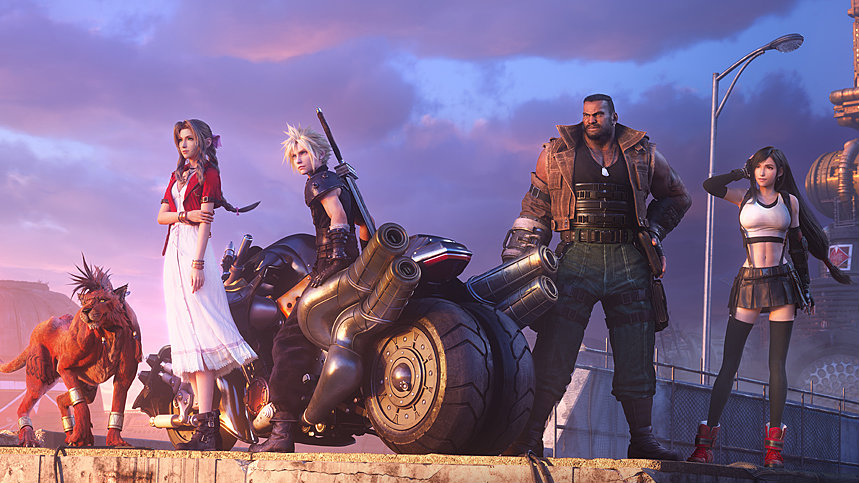
Spoilers for the Final Fantasy VII Remake (c’mon, “ending” is in the title), but also for the original Final Fantasy VII.
When I first completed the Final Fantasy VII Remake, I took to Twitter in an unabashed frenzy, my thoughts on the game’s ending spiraling out of control, as if I was trying to exorcise a demon inhabiting the deep recesses of my being. As you may notice with the timing of this essay, I have not been on the pulse, so to speak, in regards to this game’s months long unwinding discourse. I took a ridiculously long time with my first play through of the game—something I have blamed gingerly on pandemic depression inhibiting me from enjoying my own hobbies in the same way that I used to, but I won’t get into that too much. It just needs be remarked that having such a visceral, psychologically gut-wrenching reaction to it as I did, I am glad that I waited until now to let it temporarily take over my entire life–I wish I was joking, but we all know I’m not.
I have spent the last 48 hours of my life reading and watching reviews, and intensely meditating on the emotional investment that I had with not only this game, but the original Final Fantasy VII as well. I took a trip in my own quarantine induced psychological neurosis–a bit of soul-searching–into my own expectations for the game, the historical context of this remake, the challenge of constructing a satisfying narrative for a remake in general, and why being presented with meta-narrative alternate timeline hi-jinks made me feel as if something that I came to know and love was congealed into something uncomfortable and wrong. Eventually, somehow, almost unbelievably, I stumbled through intense fear and disgust at the decisions by the developers into changing my outlook on the game as one of the most impressive and impossible pieces of media to ever exist. The ending, by proxy, a twisted, brilliant and complicated response to over two decades of fan-whingeing, theorizing and excitement.
As I was playing the Remake for the first time, I enjoyed learning about Jessie, Wedge and Biggs’s backstories, even though I did not realize that the personal investment in those characters would amount to anything more than pathos when it came time for them to die. I loved the main protagonists’ characterizations as well; Advent Children, which I’m not a fan of, perfectly encapsulates how the characters have been pigeonholed into cardboard cutouts. Along with Kingdom Hearts, it is a major piece of media that represents Aerith as this ethereal angelic figure with a lofty, lilting voice rather than her quirky, bubbly and snarky self. Cloud is often portrayed as this bad ass, stoic, battleworn figure rather than a young man with a heart of gold who is not who he thinks he is. He’s merely projecting the identity of a bad ass, stoic, battleworn figure. The Remake rights these wrongs, and many others, with subtlety and care, exploring the characters’ emotions, motivations, and relationships in a complicated, nuanced way–well, most of them, anyway.
So, I want to begin by ignoring my fears and my initial, cataclysmic melodramatic reaction and talk about how I’ve come around to thinking the decision to defeat destiny (to, as far as we know, defeat the ‘whispers’ who are harbingers of fate and by extension, free the characters and storytellers from the chains of the canon and the original Final Fantasy VII timeline) is an interesting one that enables the developers to do whatever they want with the story, unhindered by the purists. Instead of merely extrapolating on one-dimensional characters and adding flavor text to what already existed, the game’s story is no longer beholden to what we know to be ‘true.’ At first, I had war flashbacks to Kingdom Hearts, a game series that I absolutely adore, but one that was clearly written as it went along. I realize that comparing the Final Fantasy VII Remake to Kingdom Hearts just because it has time travel and ‘destiny’ is disingenuous and a projection on my own part based in my love-hate relationship with Square Enix’s past. As far as I can see, as of right now, the whispers were a carefully made, extremely risky choice rather than a wacky plot contrivance. If I were to ignore the voice in the back of my head that’s screaming about diminishing returns, and trust that the developers have something worthwhile and compelling planned for the future of the story, this is a strangely comforting and exciting change. Here we are, on the precipice of completely uncharted territory. Characters who died in the original are now alive, and characters who should die later in the game are now, presumably, not tied to their fate. Upon initial viewing, I felt that this might diminish the way characters’ deaths impacted me, but I think that may be something I will be able to discern with time–the original still exists, after all. I can’t aptly articulate the shock of seeing Zack Fair alive and kicking–a sentiment I share with other people in the community–it just feels…weird. It feels weird in a way that I instantly rebelled against on my roller coaster of emotions that I’m not sure I’ve stopped reeling from.
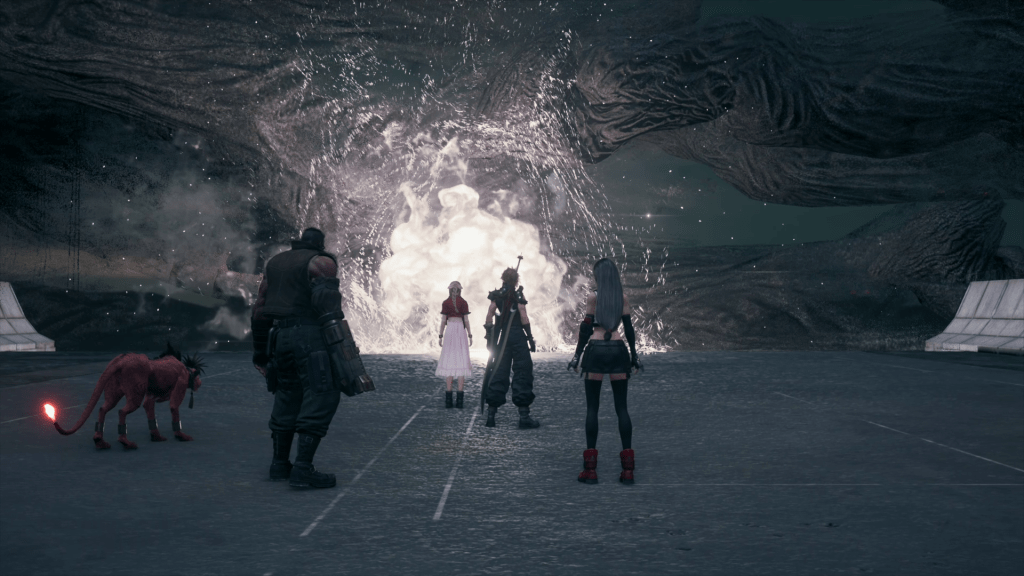
Alternatively, since the story is not set in stone, every single character is vulnerable, a sword of Damocles hanging over the entirety of the main cast. By re-making the game in the literal sense of the word, they remove the possibility for fans’ disappointment in how they retell the same emotional beats that we were familiar with. To paraphrase Tim Rogers’s ideas in his detailed and well-researched review for Action Button, this is a game that the audience members have been playing in their own head for twenty-three years. Its mere existence is a defiance of fate and an in-depth study on the art of remaking a title which has lived in the collective imagination of forum dwellers for two decades. In other words, as he states, it is “indecipherable without unpacking much baggage.” The developers were tasked with seamlessly merging the old and the new, placating to nostalgia, but refusing to restrict themselves within the bones of this ineffable creature that is one of the most important video games of all time. This, in a way, is respectable, bold, and fucking awesome.
Now, because I have opened my third eye and experienced the alternate timeline as an opportunity for endless possibilities does not necessarily mean that I am not concerned or critical of the game’s ending, especially in its characterization of its protagonists and villain. As SuperEyepatchWolf notes in his video, “The Impact of Final Fantasy VII: The Game That Changed Everything,” the game was so fascinating and beautiful because it was “a collection of these little human moments in the face of a larger apocalypse,” regardless of whether or not that larger apocalypse was unfettered, slow-burning environmentally destructive capitalism or a madman hellbent on destroying the planet and all life instantaneously. This beautiful collection of human moments is one that is retained in the Remake. However, he also goes on to talk about the ocean of experience that stands between Cloud and Sephiroth by discussing the Midgar Zolom. When you leave Midgar in the original Final Fantasy VII, you must cross some marshland in order to progress the story. The Midgar Zolom is a giant serpent that dwells within the marshes that will chase you as you attempt to reach the other side. The snake will utterly decimate your party, and respawns endlessly, forcing you to retreat and find a chocobo to be able to outrun it:
When you do, you see that Sephiroth has already been there, and he’s taken the same creature that felt so imposing and impossible and eviscerated it, impaling its corpse on a large tree. This is how the game builds the player’s relationship with Sephiroth: first by shrouding him in a thick layer of intrigue, then giving us an intimate view of his abilities through the same mechanics we spent the first ten hours learning, and finally, letting us crash up against this impossible barrier and then show us how Sephiroth shattered that same barrier […] Cloud’s inferiority to Sephiroth is a huge part of the game’s story, and the beauty of these moments is that they force you to see Sephiroth as Cloud does, making you feel that inadequacy, and it’s that feeling that reverberates throughout the entire rest of the game. You know how powerful Sephiroth is. You’ve seen definitive mechanical proof of it, and you also know that you will eventually have to face him.
At the end of every Final Fantasy game, you kill a god. It is known. By giving Sephiroth such a prominent role in the beginning of the game, whether or not he is from an alternate timeline or merely toying with them, gives the party, but particularly Cloud, ‘end-game’ or ‘end of story-arc’ abilities. It also, like SuperEyepatchWolf posits, removes a lot of the suspense and build-up that we experience as we understand Sephiroth’s motivation. I am not sure, if I were a new player of the games, even if I knew Sephiroth as being one of the most iconic villains of all time, that I would be able to ascertain his motivation at all from the Remake. It all seems so cryptic and esoteric to me. I do not think that I would truly understand Cloud’s relationship with Sephiroth, not only because the trauma he experiences in flashbacks of Nibelheim burning has not yet been shown to the audience, but because Sephiroth is no longer a figure working within the shadows. There is no longer a palpable inferiority between Cloud and Sephiroth that fuels our own perceptions of Sephiroth as someone who is irrevocably terrifying.
In terms of gauging his power, it is strange to me that I struggled more so with Rufus Shinra than I did with Sephiroth, a man with the power to manipulate what seems like fate, time and space itself. There’s a whiplash here that you don’t experience in the slow progression of RPG’s past, where grinding and building your characters up level-by-level and piece-by-piece feels earned, and in some cases, like a tedious slog. The adventure lies within honing your skills, getting more powerful materia and equipment, etc. At the end of Final Fantasy VII, it feels lived in. Sure, it is remarkably mind-melting and banal in retrospect or as a player coming to it for the first time in 2020, but it gives an effect of tangible growth. (I am sure there is a conversation to be had about whether or not playing Final Fantasy VII with the “cheats” to skip random encounters and to play the game at x3 speed is playing the game as it was intended to be played. That is not a conversation I’m going to have right now!) All of that is not to say that I did not enjoy the high-octane spectacles and exhilarating battle sequences– I did. I only express concern in the future of the series, and how to raise the stakes. I feel a genuine curiosity for how they will introduce believable conflict and hardship in the upcoming story, taking so much psychological power away from their antagonist.
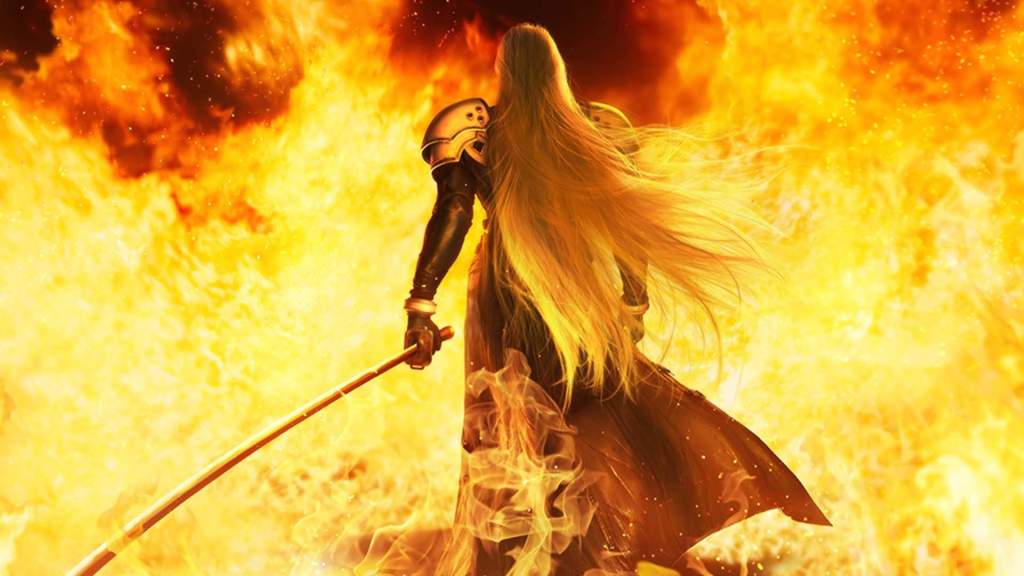
I bring up Sephiroth’s introduction because my concern lies within the Remake and its problem with scaling–There is little buildup to justify a battle with Sephiroth–if, and that is if, we are assuming that he remains the main antagonist of the series, which according to some fan theories, might not be the case. In other words, battling Sephiroth could be a red herring. The Remake potentially sets up Hojo as having a more prominent role as the series’s antagonist–he is, after all, a vile man that is enjoyable to hate–an epicenter of Shinra’s captialistic hellscape, a scientific madman with no ethics, and Sephiroth’s biological father. However, I want to veer away from speculating and theorizing. Although it is impossible to disentangle the game from its history and previous canon, the future is uncertain, and I can’t use theories and speculation as a means to justify decisions that were made in the Remake that have no foreseeable reason for existing yet. It is one thing to have faith that the story will be intriguing and worth the investment and to contextualize it within all of Final Fantasy VII-dom, and another to defend or rationalize the Remake as if it is not a singular text. I know that it is not feasible for most people to view the game within a vacuum, and I don’t think that’s productive to do even if it were possible, but it also needs to be able to stand up to scrutiny on its own.
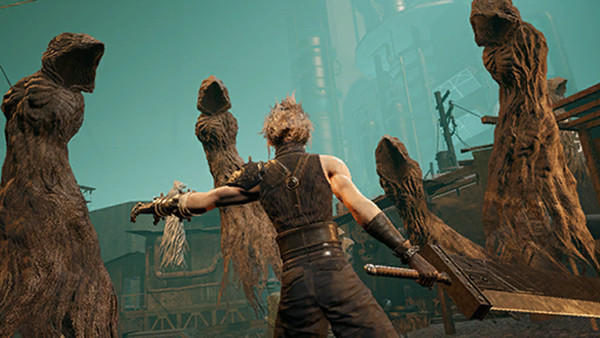
The first time I saw the whispers without knowing the game’s ending, I thought they were there to make sure that the story and characters adhered to the original timeline–which, I mean, they are, but not in the way I originally anticipated. I thought, ‘why are these ghosts here to explain why the story is taking the turns that it is? Is this some other contrived plot point made to hush those within fandom culture who need writers to hold their hand and explain every single little narrative choice?’ And that bothered me. It bothered me, as I interpreted it, that the whispers were stopping Wedge from joining our main protagonists because I saw them as an unnecessary and unwarranted explanation of something we originally took for granted: ‘of course Wedge is not joining the team, he’s not a main character, and that’s all we need.’ I see now that the whispers are a metaphor born out of a direct reaction to fandom culture, but in a way that I think is completely understandable.
One question that I have seen making the rounds is: Should I play Final Fantasy VII before the Remake? My answer is yes, for two reasons: 1) Final Fantasy VII is an amazing game. It also has a beginning, a middle, and an end that does not need to be judged within the context of anything other than itself. Yes, you could play or watch the accompanying material, but that is not necessary to enjoy the original. 2) The Final Fantasy VII Remake is a companion piece, parts of which do not hold weight without prior knowledge of the series. I see the game as part one of an attempt to patchwork all of the other companion pieces into a giant conglomeration that feels much more cohesive than tacked-on after stories. If I were to indulge my own predictions, I’d venture to guess that Vincent and Yuffie will no longer be optional characters. I would be surprised if there is such a thing as an optional character going forward. Here is where I may seem a little controversial in my take: As someone who has swallowed every single piece of Final Fantasy VII adjacent media, I’m no position to assume how this game will affect new players. It is impossible for me to look at this game as existing in a bubble without drawing comparisons. A part of me, as I looked deeper into my fears and hesitations for the Remake, realized that I am a ‘whisper.’ I am one of those annoying harbingers of fate–a purist–a person obsessed with what I knew and what I wanted to see writ large and in beautiful, highly rendered graphics. And then as soon as I realized that, I said, fuck it. I do not want to be some specter howling into the void because a game is not doing the thing I want it to. I figured, it’s time to have some faith in something new–there’s no telling what the future may hold, and that’s uncomfortable and scary, but even so, it’s anything but boring.
Works Cited
Action Button. “ACTION BUTTON REVIEWS: The Final Fantasy VII Remake.” YouTube. Available at: https://youtu.be/Hu4H5ykBP0I
SuperEyepatchWolf. “The Impact of Final Fantasy 7: The Game that Changed Everything.” YouTube. Available at: https://youtu.be/9V68GCZ61Rc


Leave a Reply