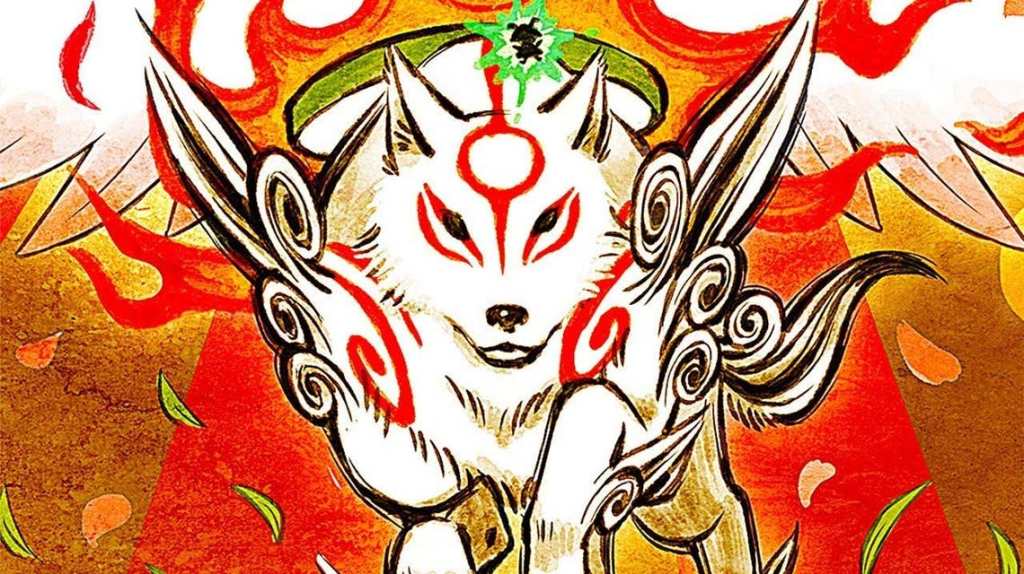
Welcome to the Land of Nippon
Ōkami (Japanese: 大神, literally “great god”, “great spirit” or “wolf” if written as 狼) is an action-adventure game where you play the role of the titular character, Ōkami Amaterasu, who is traveling the land of Nippon with her wandering artist companion, Issun. Taking place in ancient Japan and 100 years after the demon Orochi’s defeat, a mysterious figure releases the evil serpent from his binds, unleashing darkness and pollution throughout the world. It is the player’s job, as Amaterasu, to restore the cursed land by reviving these massive trees called guardian saplings and by defeating demon portals in order to free the people, animals, and natural life from the vice grip of evil. Throughout the game, Amaterasu harnesses powers given to her from the other gods who are trapped in constellations; she can eventually control all of the natural elements (such as fire, water, wind, etc.) by using a paintbrush mechanic called the celestial brush. The human characters you’ll encounter will see Amaterasu as a white wolf without the markings or the reflector on her back, and some of them will lovingly call her “snowball” because belief in the gods has dwindled over the years. On your adventure, you’ll encounter a wonderful trove of memorable characters, the most important being the aforementioned Issun, who is a spunky and overly flirtatious sprite (well, poncle, which a kind of woodland fairy from Japanese folklore) who serves as a guide and the game’s comic relief, as Amaterasu is a silent character (though she does convey emotion through various howls and growls and sometimes even puts Issun in her mouth if he’s getting out of hand). Being overly confident in his pursuits to be the greatest artist ever, Issun joins “Ammy” or “furball” on her quest to rid the land of darkness so that he can learn some celestial brush techniques of his own. He is such a lovable scamp, but he is also arrogant and sometimes rude to the player, chiding you if your brushwork is imperfect. If he’s not your favorite character, you’re wrong. Unless you’re thinking about Tobi, who is also an acceptable choice.
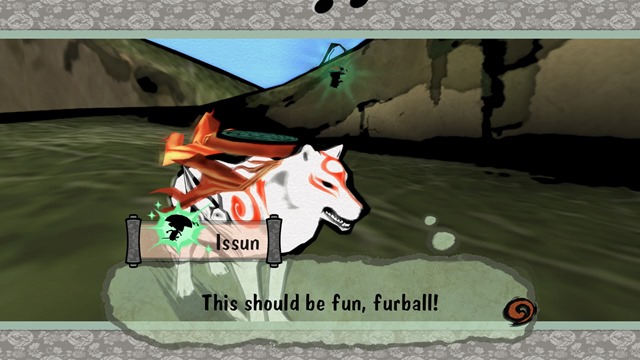
Before I played Ōkami, I was drawn to the game’s artwork and design; I was aware that you played as a white wolf with crimson markings named Amaterasu, and that people regarded the game to be an amazing Zelda clone—a term that not only have I grown to disdain for its laziness and vagueness towards the action-adventure genre, but one that I’d say does not even come close to cutting it in this case. Truly, not even close. To call Ōkami a clone of anything else would be a disservice, even if the comparison is meant to be complimentary. Look, I love Zelda. Does it take inspiration from Nintendo and fit itself into a similar niche of games within the genre? Yes. Does it feel and play like a game inspired by Zelda? Yes. But it is far, far from a Twilight Princess re-skin, which has been a popular talking point for the past fifteen years since both of their original launches. I could go into how there’s probably no grand conspiracy of video game design going on here, and how it’s probably just a coincidence that both of these games came out in such a small time frame and both contained some similar elements such as a wolf (well, in the case of Link, a sometimes-wolf) protagonist, but it’s all conjecture. For starters, this game is way easier than any Zelda game I have ever played, which is not as much of a criticism as it is an observation, though there were some fans of the game expressing disappointment that a harder difficulty wasn’t added to the HD remasters. It is a deceptively long game; I finished the main story in 37 hours on my first run, and that was before I started diving into the side quests and hidden gems that the game has to offer, so a thorough playthrough is said to be around 40. The story is vast and epic, and the combat is bold, innovative, and a bit more complex. The important takeaway here is that Ōkami is totally, undeniably different, and it should be celebrated outside of the shadow of one of the most popular franchises of all time. The game was not considered a commercial success upon its initial release, and my goal here is to convince at least one person who is as late to the party as I was to pick it up fifteen years later. It ages like a fine wine, and deserves its own space to be appreciated and lauded for its creativity and beauty.
I recently picked up the PS4 HD remaster of Ōkami, and upon finishing my first playthrough, immediately, without any hesitation, I began my second run through new game+. I can say with absolute certainty that I cannot remember the last time that I replayed a game directly after beating the final boss without any breathing room or time to contemplate what just happened in-between, and I am a replayer of games that I enjoy. It’s a consistent throughline in my life—helps keeps things in perspective over the years to return to those little nuggets of fun and nostalgia that keep you warm. But, Ōkami is different. It’s a magical experience. It’s truly unlike any other game I have ever played in my life. Finishing the game felt like ripping my heart directly out of my chest, and the only logical thing for me to do was to put it right back in.
Interweaving Mythology and Metanarrative with Artistic Flare
With Amaterasu being the sun goddess who takes upon the form of the white wolf, along with other references (such as Susano being a reference to Susanoo, a storm god who is the younger brother of Amaterasu), it is clear that the game has its roots into Japanese mythology and religion, particularly Shintō. This is evident, not only from the characters, but their values and the story’s methodology as well:
Japanese mythology speaks of an eternity of history in the divine edict of Amaterasu. In its view of history, Shintō adheres to the cyclical approach, according to which there is a constant recurrence of historical patterns. Shintō does not have the concept of the “last day”: there is no end of the world or of history.
https://www.britannica.com/topic/Shinto/Shinto-literature-and-mythology
The game’s story itself is cyclical; Ōkami Amaterasu is the reincarnated hero of the game’s folk legend, Shiranui, and we have to defeat Orochi again to rid the world of darkness. Issun is the grandson of the poncle, Ishaku, who was the Celestial Envoy who aided her in defeating the demon 100 years prior to the events of the game. Susano is the descendent of the great warrior Nagi, and the pressure of that legacy prompts him to release Orochi from his bonds in the first place. In the essay, “Representations of Japan by the Video Game Industry: The Case of Ōkami from a Japanophile Perspective,” Marc Llovet Ferrer writes that
Ōkami is by no means a story where mythological characters are used in order to fabricate a story that has nothing to do with Japanese traditional folktales; it feels more like a warped version of those tales. In Ōkami, Amaterasu’s struggle against Orochi in the first arc is actually the repetition of similar events that happened a hundred years before in the same Kamiki Village. Through that narrative element, the game establishes a series of parallelisms between those characters of the past and those of the present, the latter becoming symbolic reincarnations of the first.
Not only are we in a cycle of events that are repeating history, but we go back in time to defeat Orochi with Nagi, Ishaku, and Shiranui. We fight Orochi a total of three times, and he isn’t even the final boss, but the ultimate red herring for a person who thinks this game is going to be 20 hours. The game’s new game+ mode is prompted by the narrator asking if they should begin the story from the beginning. We are forging a myth as we are playing it, writing the story of the legendary adventure of Amaterasu and crafting her journey with our celestial brush, so that it can be cycled through, again and again.
Along with the interweaving metatextual elements and references to mythology, another unique aspect of the game is the art; using a cel-shaded visual style, Clover Studio (a subsidiary of Capcom that was later absorbed into Capcom, but let’s not get started on that whole thing) was able to make the game look like a sumi-e inkwash painting, especially with the celestial brush mechanic, which uses the same black ink and calligraphy inspired style in Amaterasu’s brushwork that she uses to control the natural elements and change the world around her.


The game also featured Japanese folklore and paintings in the Ukiyo-e style of Japanese art; this kind of artwork (which was widely popular during the 17th through 19th century) used woodblock prints and paintings to depict scenes from history and folk tales, scenic landscapes, and people from all walks of life. In an essay entitled “The Floating World of Video Games,” a writer for the Ruth Chandler Williamson Gallery discusses the game’s art style as influenced by Japanese art and culture:
Moreover, Ōkami and Ukiyo-e are linked even more inextricably. Graphically, Ōkami is grounded in the artistic styles of Ukiyo-e and sumi-e. For example, instead of a realistic aesthetic, Clover Studio created a game that would resemble a painting. Heightening that effect, the player paints as a key function of the game using one of the primary elements of the game, the celestial brush. With this brush, the player creates patterns on the screen, which then translate as the various powers of the protagonist, Amaterasu. Creating a / pattern would slash an enemy while an O pattern would make a cherry blossom tree bloom. Ōkamis plot draws on various elements of Japanese folklore and Shinto religion, just as Japanese woodblock prints did. Amaterasu, the protagonist of Ōkami, is the sun goddess of the Shinto faith, personified as a white wolf in the game. She helps the hapless Susano (the Shinto storm god) slay the eight-headed serpent Yamata no Orochi. The depiction and retelling of Japanese legends was a staple in Ukiyo-e prints, used as entertainment and as a way of perpetuating beloved stories. Ōkami is a modern-day extension of this same practice, transforming classical Japanese legends into a form modern audiences find relevant.
https://rcwg.scrippscollege.edu/blog/acquisition-essays/the-floating-world-of-video-games-2/
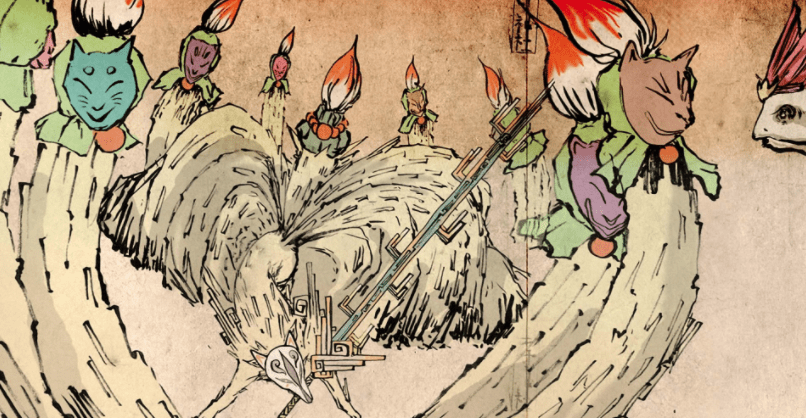
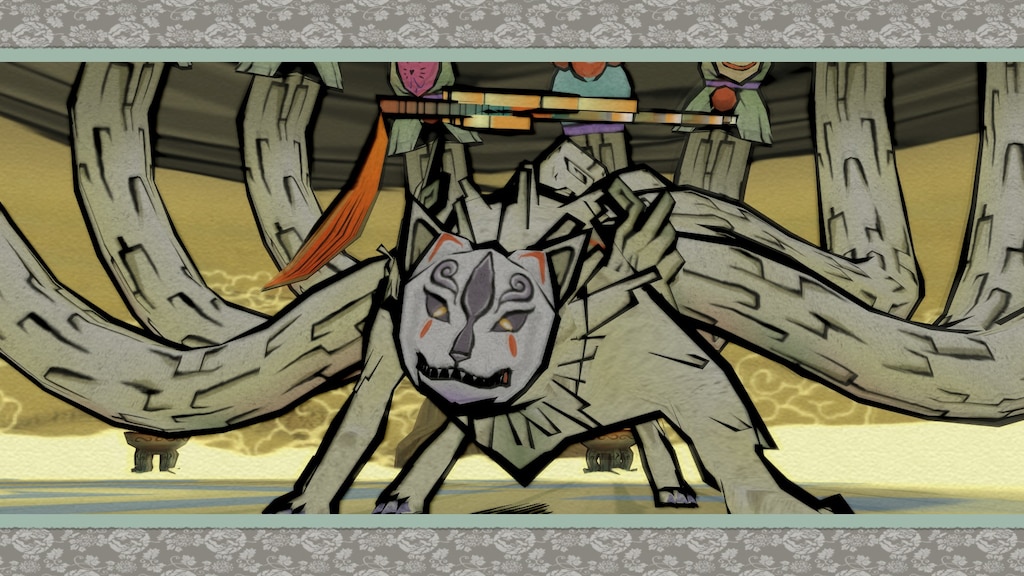

Painting is a key mechanic of the game, as well as being a primary component of the visual aesthetic, which leads me to discuss one of my favorite aspects of the game: the metanarrative of the celestial brush and the player’s godhood as visualized through the roleplaying of Amaterasu. As players, we always hold some godlike dominion over the world of story, but in this game, it is not even sub-text. Many people have questioned why the game is so easy; and while I am not dismissing their criticism or hopes for an eventual difficulty setting to be added, I think the game is easy on purpose. Within the game’s scope, Ammy is a god who is playing out her own legend. Her power increases to virtually insurmountable heights in new game+; there are 100 stray beads scattered throughout the land, and the mysterious prize awarded for collecting all of them is a holy artifact called the String of Beads, which when equipped, grants Amaterasu infinite solar energy (health), gives her unlimited ink for the celestial brush, and increases her attack power by tenfold. An item like this one makes her basically invincible, and it is only one item in the game—there are tons that give stat boosts, but the beads just happen to be the best one available. The astral pouch, when filled with delicious food from her adventure, will completely revive Amaterasu multiple times, and the amount of solar energy that she can get makes the game ridiculously easy. Amaterasu becomes more powerful without the aid of items by eliciting praise from helping people or restoring the land; this praise, a seemingly infinite resource, especially on new game+, makes her overpowered without the need of any items. So, all of this considered, it is my belief that the game’s ease lends itself to the metanarrative.
As an Analogy for Climate Change
The importance of nature cannot be understated in the world of Ōkami; as previously mentioned, the game, much like Studio Ghibli films, uses its fantastical setting to explore the principles of Shintō. Charlies Newell writes that
Miyazaki uses these movies to explore Shintō, its idea of purity, humanity’s relationship with the spirit world, and modern Japan’s environmental concerns.
https://www.asianstudies.org/publications/eaa/archives/the-films-of-hayao-miyazaki-shinto-nature-and-the-environment/
So, while these movies and Ōkami are distinctly Japanese, and like Princess Mononoke, the game does not take place in a modern setting where unfettered capitalism is raging, their messaging about the importance of restoring natural environments span across time and culture. As I discussed in the previous section, the game has a cyclical framework; the idea that we must learn from our mistakes of the past to prevent the tragedies of the future is embedded in its very fabric. In 2021, the metaphor is clear: the land is being ravaged by pollution and desolation, and our only hope for our own survival is to save our planet from destructive forces (whether those are serpent demons or unregulated companies and neglectful governments). Even if you don’t want to look at the game as analogy for climate change (and I will say, it’s less on-the-nose than the Final Fantasy VII Remake as any direct political allegory), it is succeeding in its effect when there is a depth to the emotions that you feel when faced with these beautiful, awe-inspiring, scenic landscapes. When we succeed in preserving or saving these environments, we also save the people who live there.

It’s The Little Things
The music is absolutely gorgeous in this game; in particular, “Theme of the Celestials,” “Reset,” and “The Sun Rises” hit different once you’ve completed the game’s story;. The overworld track “Shinshu Field” (神州平原; Shinshū heigen; Plain of the divine state) is gorgeous, sprawling, and epic, yet somehow also soothing and calming. This dissonance matches the game’s pacing and themes, I believe. There are creeping, building fights with larger-than-life forces of evil juxtaposed with small, meditative moments, such as when you feed the animals throughout Nippon. Even on a heroic quest where the gods are raging a war against demons and the stakes couldn’t be higher, we have time to reflect and enjoy these moments of peace. The music is tranquil and the adventure pauses for Ammy to become one with the creatures around her.

When running throughout the valleys and forests of Nippon, grass and flowers will bloom from under Amaterasu’s feet; when you build momentum, the grass becomes longer and golden, like the sun. Instead of holding a button to run, you just get faster and faster as you build that momentum; it makes the game feel liberating. The controls are tight and concise enough to lend themselves to the 3D platforming puzzles, but they are also free and loose when you’re going as fast as you possibly can. While running in the snowy land of Kamui, Ammy produces snowflakes instead of grass and flowers. When Kusa village is under an evil curse, Ammy can’t use her brushstrokes and her power consistently drains (unless you’re wearing the String of Beads, where you still can’t use the celestial brush, but the ink doesn’t drain). In this area, the grass under becomes dead and withered when Ammy runs.


All of the characters in the game are quirky and unique. Even the imps, who you spend the entirety of the game fighting, have fun personalities and dialogue when you infiltrate the Moon Cave and disguise yourself as one of them. One of the favorites is Orochi’s head chef, Ajimi, who is extremely campy, and calls Amaterasu “sweetheart,” and “powderpuff” after you save him from boiling to death in his own soup. One of the other imps even admits that he knew the chef was in the soup, but left him in there because he thought it might enhance the flavor. Another character that I enjoy immensely, besides our boy Issun, is Tobi, a sentient paper slip and gatekeeper of Oni Island who just wants to race Ammy because it is his passion in life.


There are so many memorable characters; from the flamboyant Waka who flies away leaving a trail of glitter, to the loveable Orca who helps us travel by sea, and the Canine Warriors, who I feel don’t warrant much more explanation than: THEY ARE DOGS WHO ARE ALSO WARRIORS. I was thrilled whenever I met a new person or creature—excited to learn their distinct way of talking and how their interactions with Issun influenced the dynamic between Issun and Amaterasu.
The game also lends itself to backtracking and exploration. I loved finding the little nooks and crannies (I am a sucker for nooks and crannies, in particular) looking for treasure, beads, and the small clovers underground. I realized on the second playthrough that these clovers were a reference to the studio that created the game, and they matched their logo perfectly. They are small beacons of hope growing in dark and shrouded places—something that I think we all need in times like these. There are even places from the beginning of the game that you can return to when you learn more brush techniques. Using the galestorm technique on piles of leaves can reveal treasure to dig up, and when you upgrade your power slash technique, you can cut through harder rocks, just to name a few.
Closing Remarks
I beat the game for the first time when I was playing on stream with some friends; the ending cutscene and battle were blocked by the publisher, and while they only saw a deep blackness, I was on the other side of it soaking up every bit of color. I was laughing during the final moments of the game because I was enjoying myself so goddamn much, but when I exited the stream, I had tears streaming down my face. I will not spoil the finale here: I will only say that it ties together every beautiful, intimate moment and contextualizes them all into something much grander. I want to thank my very very dear friend, Angelene, for recommending this game to me. When you tell someone else that they might like something, you never know how deeply it will resonate with them, and in the case of this game, it is now near and dear to my heart, and I am eternally grateful that I picked it up when I did. It was exactly what I needed when I dove into it, and that is a once—maybe—twice in a lifetime experience for most people. I feel myself choking up as I write this because I am a giant crybaby. To call the past year difficult…would be an understatement. We all feel enclosed and trapped, as if there is a lingering darkness that has shrouded our land and inhibited us from being able to feel like we used to. We have not been able to form human connections or to express creativity and an appreciation for the beauty in this world. Ōkami reminds us that there is something worth fighting for—that under all of that darkness, there is a hope and beauty and a world worth saving. So, Amaterasu and Issun, thank you.


Leave a Reply