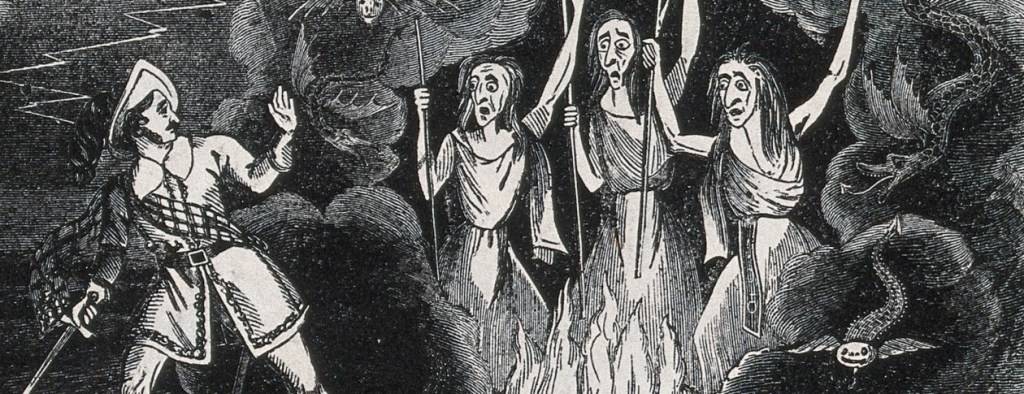
Steeped in witches and superstition, the Scottish play evokes mystery and ambiguity regarding murder, the supernatural and political corruption. From the play to the stage itself, Macbeth has a colorful reputation of being cursed to the point where it is sacrilegious to mention it by name. Under the veneer of magic and mysticism, it is easy to lose ourselves in a world where witches control fate and spirits float through dining halls, but during Shakespeare’s time, there were real witch-hunts. The representation of the witches in the play often varies from production to production. Sometimes they are cast as seemingly normal women, huddling together in tattered clothes and gathering up body parts to cast their spells, but they can also be interpreted as ethereal soothsayers and oracles of true prophecy—a link between the spiritual realm and humanity. Where evil derives in the play—whether it be from the characters’ own free will to commit violence or from supernatural forces controlling their every move—is open to audience and directorial interpretation. In a time where witches were historically considered a genuine threat to the safety and religious sanctity of society, the play invites our skepticism and its ambiguity questions the existence of those supernatural forces at work, or whether evil comes from within our own minds.
Witchcraft and witch-hunting reached its height during the years 1575-1675 throughout most regions of Europe. Most of these witch-hunts occurred in rural areas with political unrest, and although punishments for witchcraft depended on the exact time period, region and laws, many of those who were accused were women or those on the margins of society. As noted in Jonathan Durrant and Michael D. Bailey’s Historical Dictionary of Witchcraft, “particularly elderly, poor women, tended to be more vulnerable to witchcraft accusations because they lacked the protection of male relatives. Such women were on the increase in early-modern Europe because of intensification of […] agrarian crisis and inflationationary cycles” (19). Macbeth’s witches are often envisioned as poor, sick, or meek looking women. Some interpretations even show the witches as embodying the triple goddess archetype of Neopagan folklore: the maiden, the mother and the crone. The “Triple Goddess,” often symbolizes different stages of a woman’s life cycle in connection to nature.
As Russ McDonald writes in The Bedford Companion to Shakespeare, the “English agricultural economy was varied” (229). Many people living in rural early-modern England would have been tenant farmers. According to McDonald, much of the land was communally shared and worked on by its citizens, and the feudal system of land ownership had mostly been resolved. However, he also notes that the agricultural economy during Shakespeare’s time was complicated. It was in a state of flux and as he puts it, “momentous change”:
From time to time the lord of a manor sought to raise rents and thus make the land more profitable, although the lord’s long-standing affiliations with the community usually kept greed in check. The more serious threat was the sale of property to merchants or other newly prosperous men from London who wished to consolidate the lands into larger, more productive farms and whose distance could easily insulate them from local hardship and complaint […] Such problems are best represented by the disputes over enclosure that became more and more frequent and violent in the sixteenth and early seventeenth centuries. (229-230)
Many of these land enclosures forced people off of their land and into the cities in search of employment; this movement from country to city led to a population boom in London and the eventual success of Shakespeare’s plays. This political and social upheaval created an atmosphere of suspicion in these rural populations. As McDonald writes in his chapter on “Religion and Society”: “Religion and politics were virtually inseparable in the sixteenth century” (315). Living in a theocracy, or under a system of government where God was recognized as a ruling authority over daily life, accusations of witchcraft were taken seriously. What McDonald does not mention, however, was that some of these enclosures also coincided with accusations of witchcraft among rural populations. Silvia Federici discusses this in her book, Witches, Witch-Hunting and Women:
In none of the trials of which we possess records were the women accused described as victims of expropriation. It is acknowledged, nevertheless, that, as in the rest of Europe, in England witch hunts were predominantly a rural phenomenon, and as a tendency, they affected regions in which land has been or was being enclosed. (40)
The map of witch trials and enclosures overlapped, Federici asserts. Although her book focuses on women’s oppression and persecution under capitalism as it evolved as a system, it is important to take away witch-hunting as being part of an economic crisis as well as being socially and religiously motivated. Knowing that poorer, marginalized women were often targeted in these hunts sheds some light on how it is possible to interpret their role in Macbeth; if the witches are commoners, rooted in home and hearth, their position in the play is somewhat revolutionary. They would be common people intervening with the lives and deaths of royalty, resetting their country’s ruling class from behind the scenes. A more historical analysis of this detail can be interpreted as rather insidious, however, implying that the ruling class was paranoid of the power that common people held, even if that power is an abstract, hypothetical concept born of fear rather than a reality. Especially if these “witches” were oppressed in their gender and social class, they would have had reasons to dislike or distrust overarching patriarchal and religious structures, and could therefore threaten the status-quo.
While living in London, it is unlikely that Shakespeare would have attended a witchcraft execution, be privy to an accusation, or been personally affected by witch-hunting, but the theocratic culture of early-modern England would have made Shakespeare aware of the severity and significance of witch-hunting during his lifetime. Like much Shakespearian scholarship, there are wide gaps in our knowledge, so this speculation is merely based on Shakespeare’s life as a playwright in an urban setting rather than a rural one. As Jonathan Durrant and Michael D. Bailey contend, “periodically, witches and witchcraft have interested playwrights, particularly in the England of King James I. At this time, witch prosecution was steadily declining in the country” (150). Despite witchcraft declining, King James’ obsession with superstition influenced playwrights, like Shakespeare, who was writing under his blessings and patronage. “The most famous of these Jacobean plays was William Shakespeare’s Macbeth (1605), in which Macbeth consults the three witches on the heath.” (150). Durrant and Bailey then go on to list other prominent plays that were written on the subject of witchcraft during this time, some of which were “based on real-life events.” These plays include The Witch of Edmonton (1621) by William Rowley, The Late Lancashire Witches (1634) by Richard Brome, The Wonder of Women, or the Tragedy of Sophonisba (1606) by John Marston, The Masque of Queens (1609) by Ben Jonson, The Tempest (1611), also by Shakespeare, and The Witch (ca. 1612) by Thomas Middleton. For the purposes of diving into the historical landscape of Macbeth, Durrant and Bailey illuminate the prominence of witchcraft, magic, and conjuring during plays and the public consciousness at this time. They also discuss the distinction of religion and magic as being blurry, an idea that Macbeth’s question of responsibility touches upon as the supernatural elements of the play are ambiguous.
Macbeth is thought to be written between 1605 and 1606, and one of Shakespeare’s influences in writing the witches in his play would have been King James I’s Daemonologie (Demonology). In the preface of Daemonologie, King James asserts:
The fearefull aboundinge at this time in this countrie, of these detestable slaues of the Deuill, the Witches or enchaunters, hath moved me (beloued reader) to dispatch in post, this following treatise of mine, not in any wise (as I protest) to serue for a shew of my learning & ingine, but onely (mooued of conscience) to preasse thereby, so farre as I can, to resolue the doubting harts of many; both that such assaultes of Sathan are most certainly practized, & that the instrumentes thereof, merits most severly to be punished (xi).
He divides the book into three parts: the first on the subject of magic and necromancy, the second on witchcraft and sorcery, and the third on a discourse of spirits and specters. King James viewed witches and sorcerers as working for the devil, and their existence as a threat to society that could only be expunged by death and extreme punishment. King James was, as Howell V. Calhoun notes, “addicted to superstition and a belief in witchcraft,” and it is possible, with King James being a patron of the theater, that Shakespeare catered his representation of these witches based on his monarch’s publications on the subject, as well as his intense paranoia of regicide. Calhoun discusses Scottish witchcraft as an “elaborate demonical science” based on heresies and English witchcraft, in contrast, as being “a very homely and primitive affair by comparison, having its roots mainly in the domestic life of the lower classes” (184). King James bridged the gap between Scotland and England with his rule, blurring the distinctions between the lore and “science” of demonology for both countries. Although there was skepticism towards James I in terms of his beliefs in witchcraft as a crime punishable by death and his extreme dedication to the divine right and absolute monarchy, his work was “a statement of personal beliefs, rather than a scholarly study of the subject, and consequently was respected in that light by all those who sought to ingratiate themselves into the favor of the king” (185).
Macbeth’s elements of folklore, witchcraft, spirits and the supernatural are attributed to the influence of King James I, and the play is often recognized as being written as a means to gain his favor. Macbeth plays with two elements of James I’s paranoia: witches and regicide. Besides viewing witchcraft as a general sin, James I claimed that witches tried to take his life on multiple occasions, specifically Angis Sampson, who was implicated after confessing to using human body parts in a spell in order to sink his ship during a storm. Scholars are not entirely convinced that there is truth to these accusations and confessions. In his lecture for Gresham College, James Wright discusses how that voyage changed James I’s perception of witchcraft so much that when he returned to Scotland from Denmark in 1590, over 100 people were executed under the presumption that they were in a coven, and they played a role in conspiring his death. “James took this very, very, very personally and he actually acted as the interrogator in several of these cases,” Wright explained (1:14-1:22). It goes without saying that a member of royalty, especially a king, acting as judge, jury and executioner does not exactly fare well for the accused.
“The Gunpowder Plot,” an infamous terrorist plan designed to kill James I and his entire Parliament, was also discovered and defused, but the betrayal that James I felt towards his people shook him to the core. In his novel, Witches and Jesuits, Garry Wills states: “The King disseminated his official version of religious propaganda” (15). Wills affirms that gunpowder was viewed as being of the devil, so the connection between the two elements of James I’s fears are clear: “The key to the King’s interpretation of the Plot was its subsumption into the apocalyptic reading of history that was the center of religio-political ideology at the time” (16). This view of regicide as a “harbinger of the world’s end” is also evident within the play, as nature and the heavens react to Duncan’s death: “Thou seest the heavens, as troubled with man’s act / Threatens his bloody stage” (2.4.4-5).
Macbeth’s witches are supernatural, hag-like, and described as having beards; their brewing and concocting of spells that affect the events of the play do not challenge or dissuade King James’ hostility and intense fear.
What are these,
So withered, and so wild in their attire,
That look not like th’inhabitant o’th’ earth
And yet are on’t? (1.3.37-40)
Shakespeare describes the witches as being inhabitants of earth that do not fit in as if they are not human, or they are actually otherworldly. Likewise, the play renounces regicide as being against nature—the ultimate folly of ambition and product of evil. Yet, Shakespeare’s representation of the witches and regicide is not simple and one-dimensional; where King James and many others in rural communities blamed and accused women of witchcraft, the play’s ambiguity opens up a larger inquiry as to whether Shakespeare truly believed in the supernatural as having power over human emotions and deeds.
It is important to note some speculation in terms of Macbeth’s authorship. Thomas Middleton, one of the playwrights listed by Durrant and Bailey, is thought to have written all of 3.5. and the Hecate passage in 4.1., possibly doctoring the play and adding more spiritual intrigue. Shakespearean scholar A.C. Bradley extrapolates:
These passages have been suspected (1) because they contain stage-directions for two songs which have been found in Middleton’s Witch; (2) because they can be excised without leaving the least trace of their excision and (3) because they contain lines incongruous with the spirit and atmosphere of the rest of the Witch-scenes. (Shakespeare Online)
The addition of Hecate, the Greek goddess of magic and witchcraft, strengthens a reading where magic dictates the actions of the characters within the play. Her presence in the play also gives the lesser, unnamed witches a clear motivation, where many interpretations of the play as ambiguous rely on the witches having none. Shakespeare’s witches, with these suspicious parts removed, on the other hand, are more ambivalent plot devices—their place in the unfolding events is entirely dependent on how the audience or director interprets the play.
The varying degrees of responsibility in Macbeth are a point of intrigue with no “real” underlying truth or message; the brilliance of the play lies within this ambiguity. Macbeth is written with a witch-hunting, paranoid ruler in mind, and yet, instead of condemning the three witches for conspiring and controlling Macbeth, there’s an uncertainty in their role. The witches are not the villains of the story, but archetypal representations that stir up confusion. It is possible to read them as puppet masters, pulling the strings and enacting murder and revenge from behind the scenes, but it is also possible to view Macbeth and Lady Macbeth’s ambitions and actions as solely theirs, and their vision of the prophecy as tainted by their own desires to depose and usurp. The witches tell Macbeth that he will be Thane of Cawdor and then king, and that Banquo will beget kings yet not be a ruler himself. Banquo warns Macbeth not to heed the witches: “And oftentimes to win us to our harm / The instruments of darkness tell us truths, / Win us with honest trifles to betray’s / In deepest consequence” (1.3.121-124). He admits that even if these weird sisters are telling the truth, seeking after these new titles for political gain will do Macbeth harm. Macbeth internalizes the prophecy, saying to himself: “This supernatural soliciting / Cannot be ill, cannot be good. / If ill, Why hath it given me earnest of success / Commencing the truth?” (1.3.130-132). He deliberates about his choice, weighing the temptation of success and accolades against his own nature, which at this point in the play, we can read as not being wholly evil or murderous. He then, briefly, decides to let the supernatural act on its own accord: “If chance will have me king, why, chance may crown me / Without my stir” (1.3.143-144). However, this passivity changes as the play goes on and we dive deeper into Macbeth’s desires, fears and paranoia. Lady Macbeth seeks to urge her husband to act on his ambitions, even if he is initially hesitant to do so.
That I may pour my spirits in thine ear
And chastise with the valour of my tongue
All that impedes thee from the golden round
Which fate and metaphysical aid doth seem
To have thee crowned withal (1.5.24-28)
A common reading of the play is to attribute responsibility to Lady Macbeth, painting Macbeth as a victim of the supernatural and his wife’s manipulations. Lady Macbeth even uses language that evokes magic and witchcraft, pouring her “spirits” in his ear as a means of stoking his ambitions and encouraging him to take action. However, later on in the play, there is a power shift, as Macbeth spins more and more out of control from his own grief and guilt. He bitterly plots Banquo’s death as a response to the witches’ prophecy:
No son of mine succeeding. If’t be so,
For Banquo’s issue have I filed my mind,
For them the gracious Duncan have I murdered,
Put rancours in the vessel of my peace
Only for them, and mine eternal jewel
Given to the common enemy of man
To make them kings, the seeds of Banquo kings.
Rather than so, come fate into the list
And champion me to th’ utterance. (3.1.65-73)
In this passage, Macbeth confronts and challenges fate. Bitterly remarking that he has no children or legacy beyond his current suffering, he decides to take fate into his own hands, hiring two murderers to kill Banquo. At this point in the play, if Macbeth was ever under Lady Macbeth’s influence, he has broken free of her, and is acting out of his own fear and anxiety. Stephen Greenblatt writes in his introduction to Macbeth in The Norton Shakespeare: “Macbeth is fully aware of the wickedness of his deeds and is tormented by this awareness. Endowed with a clear-eyed grasp of the difference between good and evil, he chooses evil, even though the choice horrifies and sickens him” (2557).
By 4.1., Macbeth is no longer a passive participant to fate. He seeks out the witches: “I conjure you by that which you profess, / Howe’er you come to know it, answer me” (4.1.66-67). He demands their knowledge in order to secure his throne and to kill anyone who stands in his way. It is also important to note that Macbeth is now taking upon the language of witchcraft, saying the word “conjure.” We can compare these lines to Lady Macbeth’s ear pouring spirits, showing that the two of them have embraced this magic and witchery at different points in the play.
It is impossible to answer whether Macbeth’s fate lines up with prophecy because it was all magically foretold, or if he willed that prophecy into existence with his own actions. In the first scene, the audience is introduced to one of the consistent themes of the play: deception. “Fair is foul, and foul is fair” (1.1.10). Duncan’s words before seeing Macbeth foreshadow his betrayal: “There’s no art / to find the mind’s construction in the face” (1.4.12-13). It is clear that Shakespeare was interested in exploring how the superficial aspects of a person are not entirely as they seem. Multiple times during the play, Lady Macbeth urges her husband to change his face or attitude in order to fool those around them. Macbeth eventually embraces this deception: “False face must hide what the false heart doth know” (1.7.83). Upon first glance, Macbeth appears to be working within James I’s cultural narrative of witchcraft, attributing all of this murder, political corruption and regicide to secret prophecies, spell-books and cauldrons. Perhaps the witches embody these evil forces that tempt and sabotage humanity, giving a voice and tangible form to Macbeth’s murderous ambitions, or they plant the seed that corrupts Macbeth and leads him to spiral further and further into darkness. Perhaps, they only have as much power over Macbeth as he allows them to over his own mind.
This deception also alludes to what Greenblatt refers to as “the border between fantasy and reality” (2560). There is no way to know what is fact and what is fiction; the play transpires in this limbo that I deem to be intentional on Shakespeare’s part, giving him the freedom to explore fantastical elements without offending his king or audience.
If these effects could be unequivocally attributed to the agency of the witches, the audience would at least have the security of a defined and focused fear. Alternatively, if the witches could be definitively dismissed as fantasy, or fraud, the audience would at least have the clear-eyed certainty of witnessing human causes in an altogether secular world. But instead, Shakespeare achieves the remarkable effect of a nebulous infection, a bleeding of the demonic into the secular and the secular into the demonic. (2560)
Shakespeare toes the line between this fantasy and reality, merging political corruption and murder with magic and mystery.
Early-modern audiences of Shakespeare’s Macbeth might have been skeptical of, fascinated by, or genuinely fearful of the witches in the play. Watching or reading Macbeth through a modern lens often requires students at the high school and graduate level to analyze the witches as they primarily exist within the text. This ambivalence, however, is a larger issue that cannot be contained in the literary world. The witches’ role in this play can show us how remarkably subversive Shakespeare was in terms of challenging ideas and posing complex questions about the religious atmosphere of early-modern England. With their lives controlled by the church and the crown, the witches’ wild, disorderly chaos might have encapsulated what audiences during Shakespeare’s time already deemed to be true in their own minds about witchcraft. Audiences now will see the witches as evoking a familiar literary trope, but we must also take into consideration that the persecution of witchcraft has a bloody, unjust history, and there’s more to this story than cheeky superstitions or fun frights. Shakespeare does not shed light on the victims of those murdered under the name of religion or King James’ paranoia, but he does present us with this confusing, unanswerable question of responsibility that keeps us from forming a definitive moral conclusion. Instead of representing the supernatural as a real, ever-present conspiring force in the lives of the characters, he leads his audience to see beyond the demonic and into humanity’s liability in our own actions and power over our own fates. This ambiguity, whether purposeful or not (although I lean on it being so by design), is a form of ideological rebellion, pushing against this view that the demonic arts are to blame for all of the evil in the world. Perhaps, like James I and his crusade against these poor, innocent women on the fringes of society, evil derives from within, and not everything is as it seems.
Works Cited
Albright, Daniel. “The Witches and the Witch: Verdi’s Macbeth.” Cambridge Opera Journal. Vol 17, No. 3, pp. 225-252. Cambridge University Press, November 2005. https://www.jstor.org/stable/3878296
Calhoun, Howell V. “James I and the Witch Scenes in ‘Macbeth.’” The Shakespeare Association Bulletin. Vol 17, No. 4, pp. 184-189. Oxford University Press, October 1942. https://www.jstor.org/stable/23675195
Durrant, Jonathan and Michael D. Bailey. Historical Dictionary of Witchcraft. 2nd ed., Scarecrow Press, October 2012.
Federici, Silvia. Witches, Witch-Hunting, and Women. OverDrive App, Oakland, CA: PM Press, 2018.
James I, King. Demonology. Project Gutenberg Ebook, 1597.
McDonald, Russ. The Bedford Companion to Shakespeare: An Introduction with Documents. 2nd ed., Bedford/St. Martin’s, 2001.
Shakespeare Online. Macbeth Glossary, 2019, http://www.shakespeare-online.com/plays/ macbeth/macbethglossary/macbeth1_1/macbethglos_hecatelines.html. Accessed 10 Dec. 2019.
Shakespeare, William. The Tragedy of Macbeth. The Norton Shakespeare. Edited by Stephen Greenblatt et al., 2nd ed., W.W. Norton & Company, Inc, 1997, pp. 2555-2617.
Willis, Deborah. “Shakespeare and the English Witch-Hunts: Enclosing the Maternal Body.” New Perspectives on Witchcraft, Magic and Demonology. Volume 3. Edited by Brian P. Levack, Routledge, December 2001.
Wright, James. King of England, Hunter of Witches—James I. YouTube. Museum of London. Gresham College, Dec. 2015, https://www.youtube.com/watch?v=PF_ eR-ETp4E&feature=emb_title.
 Haleiga
Leave a comment