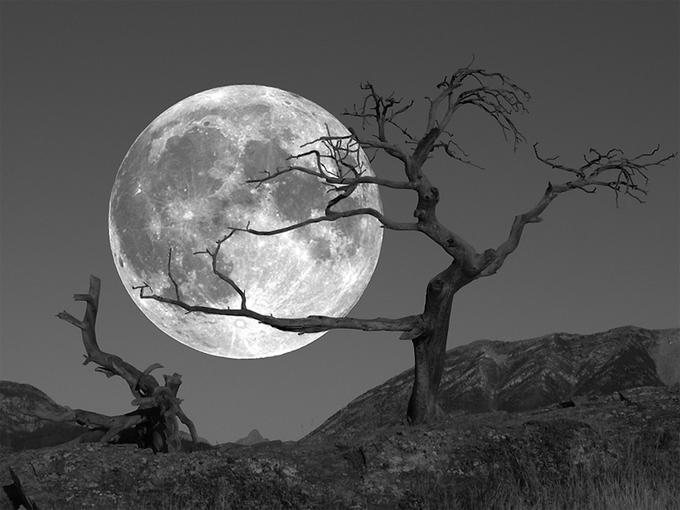
The moon is a reoccurring image throughout many of Sylvia Plath’s collected poems. Typically associated with this idea of divine femininity, in literature, the moon is often a symbol of powerful and spiritual feminine energy, and the lunar cycle is connected to menstruation. However, in Plath’s work, the moon is portrayed negatively; instead of an empowering feminist beacon, it is a cold, unfeeling, cosmic force. Plath’s representation of the moon is a critique of patriarchal notions of the divine feminine; in her work, the moon is not a gendered muse as imagined by male writers. She turns its supposedly warm and nurturing gaze into a deeply desolate one.
The third stanza of “The Moon and the Yew Tree” contrasts Plath’s representation of the moon with its stereotypical feminine associations that she is trying to reject:
The moon is my mother. She is not sweet like Mary.
Her blue garments unloose small bats and owls.
How I would like to believe in tenderness—
The face of the effigy, gentled by candles,
Bending, on me in particular, its mild eyes.” (173)
In the first line, Plath introduces a confessional, biographical element. In a journal entry from December 12, 1958, Plath wrote of her mother:
“I hate her, doctor.” So I feel terrific. In a smarmy matriarchy of togetherness it is hard to get a sanction to hate one’s mother especially a sanction one believes in. Me, I never knew the love of a father, the love of a steady blood-related man after the age of eight. My mother killed the only man who’d love me steady through life: came in one morning with tears of nobility in her eyes and told me he was gone for good. I hate her for that (429).
Plath views the moon as a failed mother figure—one that she wishes would be tender and gaze upon her with “mild eyes,” but one that she associates with her mother who she disdains for not living up to her expectations of what motherhood should be. She scorns her mother for being relieved when her father died, not loving him, and not nurturing him during his illness. Likewise, the speaker sees the moon in a similar light, as it only reminds her of isolation on earth rather than being a comfort from the reality of death. She uses the metaphor, “the moon is no door” to show its emotional inaccessibility—we cannot walk through the moon as though it were welcoming. Her use of end-stop in the lines “With the O-gape of complete despair. I live here. / Twice on Sunday, the bells startle the sky” make us linger on how she lives in that complete despair instead of the church ceremony that she brings into the next line.
Furthermore, “The Moon and the Yew Tree” focuses heavily on religious imagery; the yew tree itself is often linked to churches and spirituality, according to Paul Kendall’s article on Trees For Life,
The yew tree is another of our native trees which was held sacred by the Druids in pre-Christian times. […] The yew came to symbolize death and resurrection in Celtic culture. […] According to Richard Mabey in his Flora Britannica “… no other type of ancient tree occurs so frequently inside church grounds …” and he goes on to say that he does not know of any similarly exclusive relationship between places of worship and a single tree species existing anywhere else in the Western world.
Religion, within the poem, functions as being as cold and desolate as the moon and the yew tree:
Inside the church, the saints will be all blue,
Floating on their delicate feet over the cold pews,
Their hands and faces stiff with holiness.
The moon sees nothing of this. She is bald and wild.
And the message of the yew tree is blackness—blackness and silence. (173)
So, much like the moon is a cold and unfeeling cosmic force, the yew tree has its roots in a history of Christian folklore and tradition with its ties to death. Plath taps into this mythology by writing her poem about a yew outside of a church, with its “message” of “blackness and silence.” The speaker of the poem does not view the yew as a tree that is brimming with life, but a black object in the darkness that offers no answers. Her repetition of words such as “cold” and colors such as “blue” and “black” throughout the poem create a feeling of emotional disassociation. Although the color blue can symbolize wisdom, serenity and truth, Plath’s blue is depressing, cold, and dark. Similarly, her use of the color black is not to evoke mystery or elegance, but death.
Plath creates beautiful imagery of the night sky as being magical—She writes about clouds that are “flowering / Blue and mystical over the faces of the stars” but laces all of these images with emptiness and despair. However, it is important to note that Plath’s social critique of the moon is not ubiquitous—religions such as Wicca and some feminists have reclaimed the moon as a symbol of women’s power and strength in connection to nature instead of a relic of gendered or patriarchal expectations. Likewise, although Plath’s repeated images of the night sky often connect to feelings of smallness, anxiety, and isolation, the constellations can also remind us of the perseverance of human narratives and mythology—how stories, much like the longevity of the yew tree, are resilient, and live on much longer than our mortal bodies can. The speaker’s vision of the night is one that reminds us of the human fragility and unimportance—a dark, silent void that she sees in the yew tree. She is separated from this magical energy by the reminder of death: “Fumy spirituous mists inhabit this place / Separated from my house by a row of headstones. / I simply cannot see where there is to get to”—the tombstones act as a barrier for this mist to reach her and the mist shrouds her vision, making the reader uneasy.
Throughout “The Moon and the Yew Tree,” Plath creates a stark contrast between the cosmic realm and the human realm; her use of personification such as “the grasses unload their griefs” and “the moon sees nothing of this” make nature take on human feelings and emotions, as if nature is reacting to the speaker. However, instead of imbuing nature with this power to give life and brightness to the poem, the speaker of the poem remarks on nature as distant and uncaring. In the first stanza, she begins by talking about “the light of the mind” as “cold and planetary.”
Religion and spirituality are supposed to provide comfort to those unanswerable, existential questions about the afterlife. And yet, within the poem, the speaker describes the church itself as being cold. Most poignantly, the moon does not see the people within it; their worship is not humble, warm, or fulfilling, but rather, they float as if they are ghosts haunting the pews. The church does not serve as an escape from this anguish, but rather, a grim reminder of it. The speaker does not find solace in religion or spirituality, only blackness and silence. The tenderness of “sweet Mary” and the warmth of the candles are in the third stanza where the speaker is longing for the moon’s love that she will never receive.
“The Moon and the Yew Tree” is not only a critique of patriarchal gender constructions in nature or a confessional poem about Plath’s relationship to her mother. The poem has deep, resonating themes of emptiness that surpass a merely personal or political reading. “The Moon and the Yew Tree” is a poem that uses social critique and personal pain to paint a sprawling picture of existentialism. Her representation of the church as being stiff and unhelpful, juxtaposed with this cosmic indifference of the moon as being “wild” perhaps points to the speaker’s views of what powers govern our world. Much like Plath rejects the moon as being the divine feminine, she rejects the church—a man-made construction—as reality. The reality, the poem asserts, is silence. There are no answers to be gleaned from worship, only a cold and dark pull towards death—an unknown that we will never understand. Likewise, the moon’s wildness is the speaker’s personification of this existential chaos, verbalizing humanity’s lack of control and inability to appeal to the powers truly at be: nature.
Works Cited
Originally written for the English MA graduate program at SUNY New Paltz. Fall 2019. ENG 593: Confessional Poetry: Plath and Sexton.
Kendall, Paul. “Mythology and Folklore of Yew”. Trees for Life. Online. Available at: https://treesforlife.org.uk/into-the-forest/trees-plants-animals/trees/yew/
Plath, Sylvia. (1992). “The Moon and the Yew Tree”. The Collected Poems. 172-173. Harper Perennial. Print.
Plath, Sylvia. (2000). The Unabridged Journals of Sylvia Plath. Edited by Karen V. Kukil. Anchor Books. Print.


Leave a Reply