Major spoilers for Night in the Woods below.
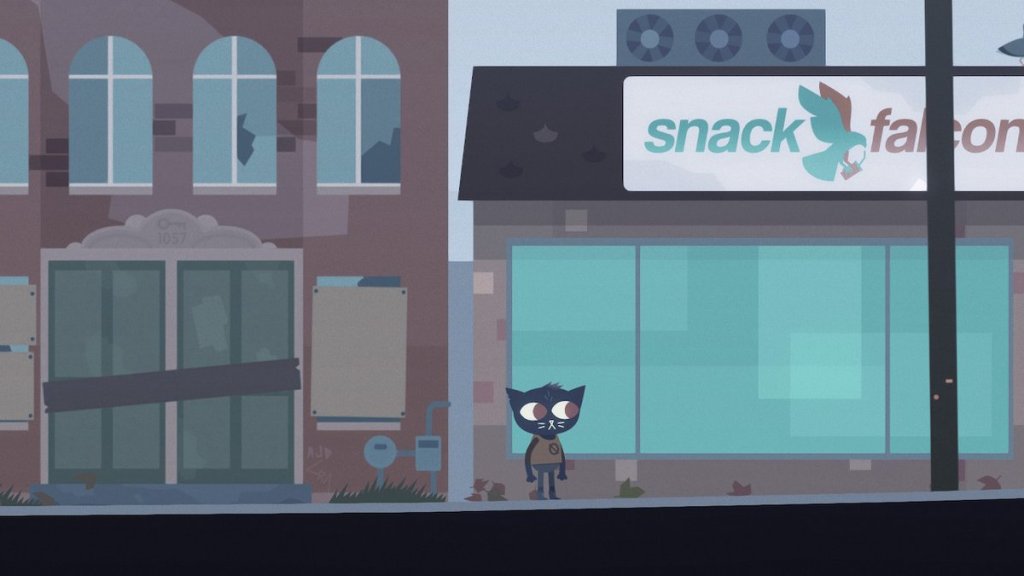
2017’s critical indie darling, Night in the Woods, is more than a 2D adventure game with snarky anthropomorphized animals romping around small-town Pennsylvania-inspired Possum Springs. Night in the Woods interweaves the personal with the political, framing the town as a living and breathing entity that has been systematically destroyed by unfettered capitalism. The game is charming and bittersweet, focusing on a tightly knit community of friends who truly love each other and how the town’s economic hardships integrate into every facet of their interactions. The protagonist, a cat named Mae Borowski, returns to her home of Possum Springs after dropping out of college. Although much of the town has retained its comforting homeliness in its familiar faces and daily monotony, she’s now faced with the slow socio-economic degradation of the town as well as that of the people within it. This place that Mae’s parents grew up in–a sprawling miner’s town run by its workers–is now a ghost-filled, Rust Belt Gothic landscape of unemployment, closed store-fronts, and desperation. Her friends (Bea the crocodile, Gregg the fox, and Angus the bear) have gotten older, and they are working minimum wage jobs, barely making ends meet, and dreaming of their escape. Mae has some growing up to do, learning over the course of the game how to move on from her own nostalgia, and finding her small, accessible role in the overwhelming political and existential plight of her hometown.
Throughout the game, Mae stumbles through the shambles of Possum Springs, reminiscing about how the small businesses that once stood as monuments in her childhood, now have boarded-up and broken windows. Whether it’s a major narrative thread, or a seemingly meaningless interaction, the game is deliberate in its class consciousness. Bea resents Mae for squandering the opportunities that she was never afforded. Gregg and Angus want to escape Possum Springs and move to a more queer-friendly neighborhood, which requires them to work constantly and save up their money. All of the NPCs’ enrich the game, and depending on who you talk to, can deepen your understanding of the characters and the lore of the town itself.
Scott Benson, an animator and illustrator (as well as one of the game’s co-creators), spoke at GDC about the game’s design and writing:
The removal of a central organizing force [such as capitalism or the belief in god] in your life […] you cannot take those aesthetics and slap them on. From where we were sitting, there’s this massive level of inequality and power and wealth…we were just trying to be honest about it. Games that are celebrated for their mature politics often will just take the aesthetics of a struggle.
The geographical area that Possum Springs is based on, known as the Rust Belt, includes states in the mid-west and the Great Lakes that suffered industrial decline in the ’80s; the places and the people that live in these areas, Benson says, are often forgotten or misrepresented, which prompted him and story writer Bethany Hockenberry to make Night in the Woods a mouthpiece for this struggle. This genre, the Rust Belt Gothic, as Professor David Trotter asserts, “allows a particular technology to reflect directly on what went before it while reflecting indirectly on what has come after it.”
Benson spoke of Mae and her friends as being “unproficient protagonists” tasked to confront “unsolvable problems”. Night in the Woods is a game that begs us to ask questions instead of giving us answers or solutions. Only through a disassociation from institutions of power can the characters find their inner selves. Mae is a character whose arc is predicated on separating herself from any institutions or authority. She dislikes the police and academia, questions the existence of god, sticks it to corporations by shoplifting, breaks into abandoned buildings, and says that she’d never go to war. And yet, the game is ambiguous in these representations of institutions as guiding forces in our lives. Mae’s aunt is a cop, and although their relationship is a rocky one, she looks out for Mae and the community’s safety. Bea challenges Mae’s flippant, privileged disregard for college, saying she would kill for the opportunity to attend if she didn’t need to look after her family business and take care of her father after her mother died. Mae’s mom works for the church, and her father works for a fancy grocery store that won’t let their employees unionize, but they are just appreciative for their paychecks. Pastor Kate’s community outreach and compassion for the homeless is deemed more important than ascribing to any strict set of beliefs, and the game itself creates its religious figures outside of any familiar to our own. In my opinion, the most beautiful scene in the game that encapsulates this theme is when Angus and Mae are in the state park and he says that he believes in a universe that doesn’t care, and people who do.
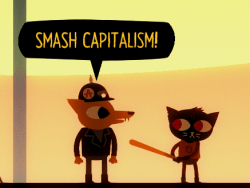 Night in the Woods explores the ways in which a community copes with modern capitalism and nostalgia. It does not merely adopt the aesthetics of a struggle and it is clear in its political leanings (see Gregg to your left), but its complexity comes with questioning these institutions of power and not trivializing individual people’s lack of autonomy in these systems. The game condemns this slow degradation caused by corruption and greed, but it does not condemn its working class characters for surviving in a world where they’re not given access to ethical employers.
The people of Possum Springs celebrate the founding of their town each year during Harfest. They perform a play and change the script to be spookier; they adapt their story through the years to new and old audiences alike. All of the places that Mae travels to research her “ghost’ coincide with a remembrance or preservation of history: the library, the historical society, the state park, and the graveyard. Night in the Woods is a game made with passion and a deep love for the improvement of these small-town communities, but one that criticizes how nostalgia for the past can become dangerous and immobilizing. The history of their town complicates their interactions with each other and the current state of the world. At the center of Night in the Woods is a contentious relationship with that nostalgia, and the many healthy and unhealthy ways to fight against the erasure of the past.
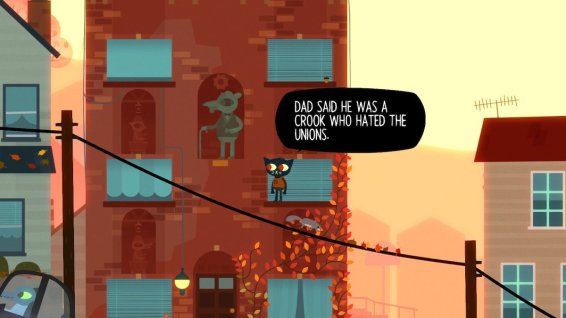
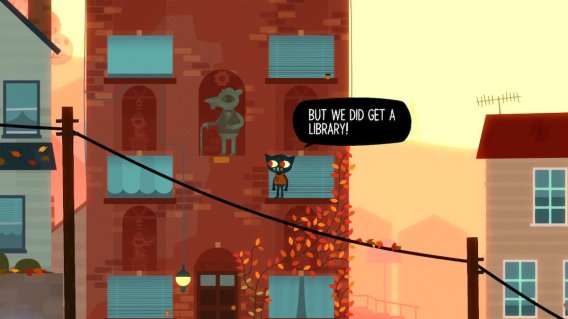
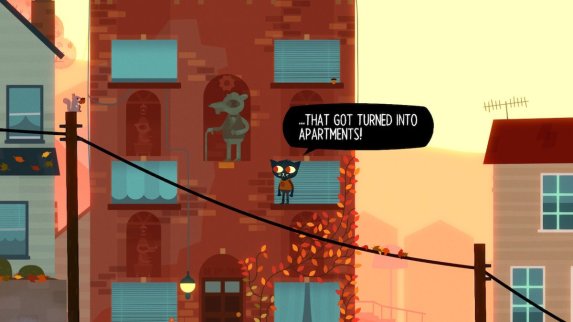
At the heart of Night in the Woods is an uncanniness; a familiar place, strangely warped by time. In their thesis entitled Sacrifice for Nostalgia: The American Small-Town and the Grosteque, Nihat Can Kantarci writes about the duality of rural America as a site for cultural change:
[T]he American small-town emerges as a site of tension that is torn between the onslaught of industrial capitalism and a nostalgic feeling towards a past that does not exist anymore. Moreover, this manifestation becomes much more palpable during social upheavals. In order to protect itself against the change, the small-town tries to act as a social body, as a unified whole against the transformation that comes with capitalism.
Kantarci discusses the American small town as a place of political tension: The modernizing world influences its social sphere, but simultaneously leaves it behind, just as the small town narratives root themselves in a nostalgia for a purer past, all the while yearning for a glory that comes with economic prosperity and relevancy under capitalism. This relationship between nostalgia and capitalism, Kantarci writes, leads to sacrifice.
During social upheavals, the small town engages in acts of ritual sacrifice in exchange for a past long gone. On one hand, we have a social order that is rapidly changing due to industrial capitalism, and on the other hand there is a constant longing for a golden age. Sacrifice, as an act of “maintenance of social order,” emerges as a third notion that results from the tension between the pulling forces of capitalism and nostalgia.
The supernatural twist in the third act–the murderous Lovecraftian cult that Mae and her friends find on that titular night in the woods–illustrates the danger in this weaponized nostalgia. These cultists sacrifice people who society has turned its back on to their Cthulu-esque monster living underground. They do so in the hopes that these killings will restore the town to its former glory. The inciting incident of the game–Mae witnessing a cultist kidnapping a child–happens in front of a statue of a soldier, a tangible symbol of a mythology they seek to reproduce. And while they don’t necessarily outright say ‘Make Possum Springs Great Again,’ the game derides this view of killing and scapegoating ‘undesirables’ to return to a mythologized past.
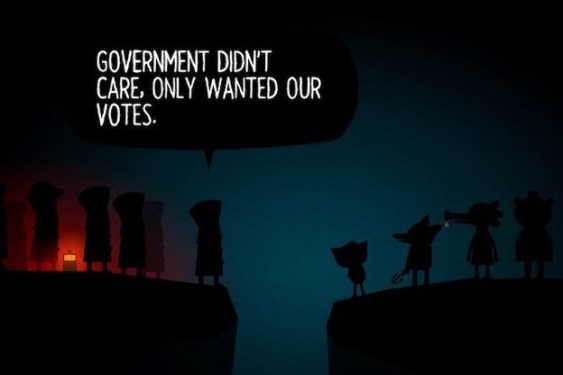
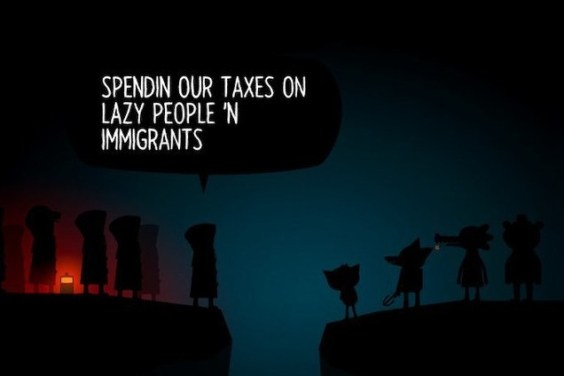
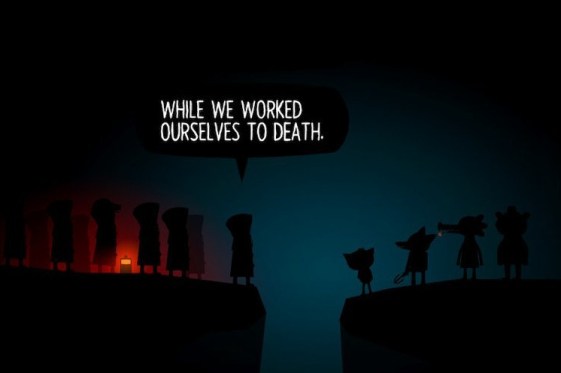
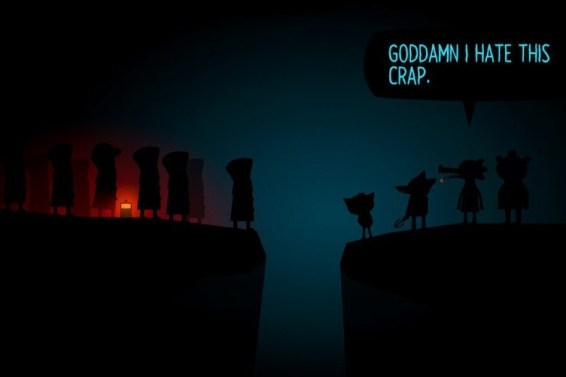
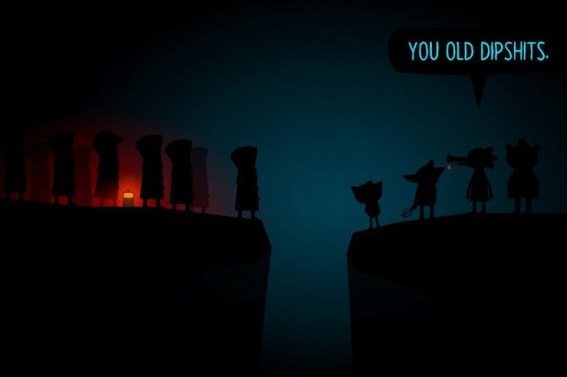
It’s quite telling that Mae mistakes the hooded figures for ghosts because, in a way, they are–holding onto a life that doesn’t exist anymore, long after their time has passed away. These cultists represent more than a chilling supernatural allegory for fascism; they show the folly of expecting complex problems to have simple solutions. Most of the time, they don’t. There is no simple solution to combat this unfettered capitalism. The Rust Belt cannot be fixed by political violence. Political violence, along with unfortunate natural disasters like the flood, put Possum Springs in the position that it is. That political violence, being, the government heavily taxing lower income areas and defunding welfare programs to stimulate big business profits and privatization. These businesses steamroll these towns and later uproot themselves to places with cheaper labor costs and wages, leaving places like Possum Springs to bask in their own ruin while their workers just barely get by. You can’t override the socio-economic degradation of a town by throwing delinquent teenagers or tourists into a pit to be eaten by a telepathic monster, just as you can’t restore a country to economic prosperity by preaching xenophobia and putting migrant children into cages. The cultists’ abuse of power is cyclical to the capitalistic system that destroyed their town in the first place.
Night in the Woods, above all else, helps us question these supposed truths of the world and the accessibility of heroism in our daily lives. It does not resign itself to defeat under these institutions and systems that dictate our existence, but it does tell us that uncertainty in our own role in these systems is not something to be feared or rejected. Uncertainty is an intrinsic part of all of our lives. People grow apart and change, history turns its pages. We can be activists that fight for a better future together, but we should also accept that life moves on and we can’t hold onto a past that no longer exists–in most cases, a past that never existed in the first place. Sometimes these ghosts of the past, like Mae’s grandfather sitting next to her as she sleeps in the church library-room, can be a comforting, familiar presence that is no longer accessible to us; their stories and memories inform our current ones. And sometimes, these ghosts haunt our present, clouding our vision of the future, rendering us unable to move on and evolve into better people. These cultists, as Bea slyly acknowledges, were not even the miners–they were not even those workers whose glory they were trying to reclaim; their version of history was a romanticized image of a life they felt entitled to, but were never given. They killed people to reap the benefits of an idea of supremacy.
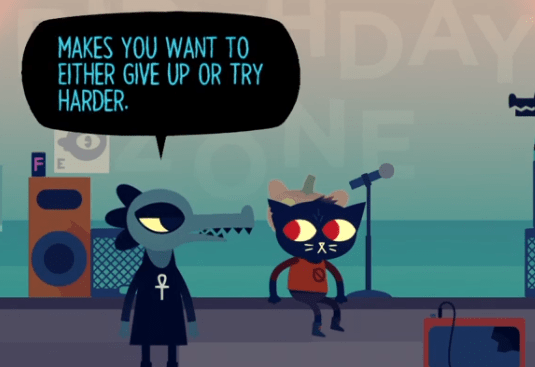
We’re not superheroes, we’re unproficient protagonists with unsolvable problems, like Mae and her friends. We as individuals cannot change the political and social landscape without help, time, research, and resources. Activism is an extremely important part of my life. So much so that sometimes I’ll go online and get worked up over my own helplessness. I can’t take everyone by the shoulders and shake them until they realize that queer people and people of color are not the ones ruining their lives, and that their real enemy are those in power who, at best, don’t care, and at worst, actively benefit from inequality and class disparities. Sometimes I feel like I’m drowning because as one person, I can’t change the world. I can change minds, but that’s a slow, exhausting and arduous process–it’s a lot of work for a result that isn’t promised to you. It sucks to realize that your impact on society might be an insignificant one, even if you’re putting in all of your time and energy into combating ignorance and fighting for people’s rights to just exist. Night in the Woods helped me come to grips with my role in my own social circle–in my Possum Springs–and to appreciate the art of the ripple affect. One person can’t put an end to the rampant bigotry on the internet, but many voices can, if they’re in unison. The game’s tagline is “at the end of everything, hold onto anything.” Playing this game, I realized, we can channel energy into challenging these institutions, educating people, and making a difference in our communities, but mostly importantly, we don’t have to do it alone.
(Mae): I think you get taught that you have a lot more control of the world than you do. I just walked into all this horrible stuff that was already happening. And I guess that’s really scary? Like who knows what’s gonna happen? But I guess you can like connect things or connect to things. Sometimes you need someone to be the thing you don’t have even if it’s something you’re supposed to already have. Am I ever going to have a handle on what just happened?
I kinda hope not.
Works Cited
Benson, Scott. 2018. “Nuke Possum Springs: A Night in the Woods Design Postmortem.” GDC. YouTube: https://www.youtube.com/watch?v=Xzhe45Q8780
Kantarci, Nihat Can. 2012. Sacrifice for Nostalgia: The American Small-Town and the Grosteque. MA Thesis. University of Missouri-Columbia. Accessible on: https://mospace.umsystem.edu/xmlui/bitstream/handle/10355/15268/research.pdf?sequence=2&isAllowed=y
Lee, Grace. 2017. Night in the Woods: Do You Always Have a Choice?. YouTube: https://www.youtube.com/watch?v=YU6AWTqNzVk
Trotter, David. 2012. “Rust-Belt Gothic: The New Technology Narrative.” The Literary Platform. Accessible on: http://theliteraryplatform.com/magazine/2012/12/rust-belt-gothic-the-new-technology-narrative/


Leave a comment